When US regulators banned a wide range of Chinese-made robots from import last week over national security concerns, most of the American robotics scene panicked. Saurabh Chandra saw an opening. His company, Ati Robotics, assembles its machines in Bangalore, India, and Chandra reckons they lean on fewer Chinese parts than nearly anyone else in the field.
That wasn’t a geopolitical masterstroke — it was a happy accident. Founded in 2017 to build motors for self-driving cars, Ati later pivoted to making its own robots: tuggers and pallet movers that haul tons of material around warehouses and factories. Building hardware in-house was a bet Chandra’s advisers warned against, but it quietly weaned the company off Chinese suppliers.
The trick was location. Bangalore’s booming electric two- and three-wheeler industry produced components with a power profile remarkably close to what Ati’s robots needed. Automotive parts tend to be reliable, high-volume and cheap, so Ati leaned on that local supply chain — sometimes re-engineering parts with vendors to make them robot-ready.
The payoff is real. Ati has several hundred robots running across more than 50 customers. Its two best-sellers show off the strategy:
- 10,000-pound tugger — effectively China-free. The only Chinese content is the battery cells, and even the lidar comes from US-based Ouster.
- Pallet mover — less than 5 percent Chinese parts, though its solid-state lidar sensor has no non-Chinese equivalent yet.
Chandra didn’t chase efficiency at all costs. Ati uses induction motors instead of the magnet-packed brushless motors favored in Chinese designs. They’re slightly less efficient, but the magnet doesn’t come from China — you simply trade a little efficiency for a bit more battery.
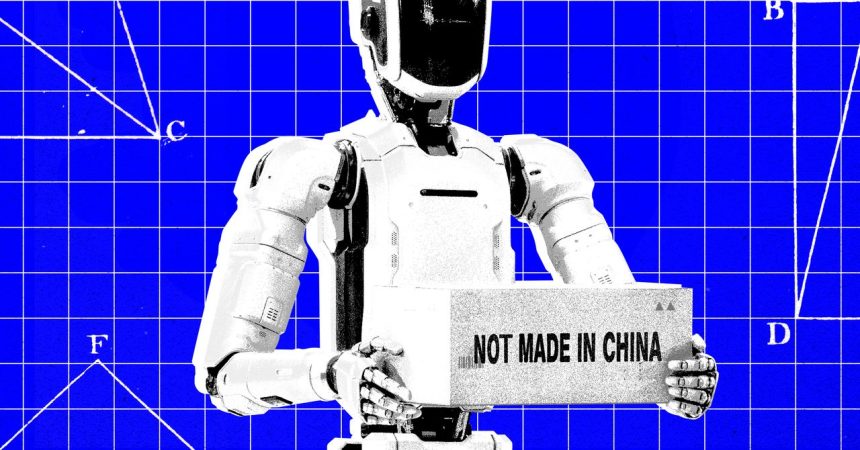
Then there’s the headliner: the Sherpa Mecha humanoid, unveiled at Ati’s Product Day 2025 event and priced at US$50,000 for research partners. It pairs two arms, a head and a wheeled base, carries a 28 lb payload at full extension, and uses 3D LiDAR for object detection, mapping, self-localization and navigation, with modular AI-driven learning for adaptivity. The arm and actuator are built in Bangalore, though the harmonic drive and frameless motor still come from China for now — as do the battery cells, which Chandra says could shift to South Korea or Japan tomorrow.
Even the humanoid’s supply chain isn’t locked in. The gears currently come from China, but they’re also made in Germany, Taiwan and Japan — pricier, but available.
Chandra doesn’t market the China-free angle loudly, though customers notice. “Most of these robots have been invented in the US. It’s a bit of a tragedy that we are not making them in the US.”
Ati manufactures everything in Bangalore today, but a facility in Madison Heights is being set up to handle assembly eventually. As for the rest of the industry’s reaction to the ban? Chandra is blunt about the road ahead.