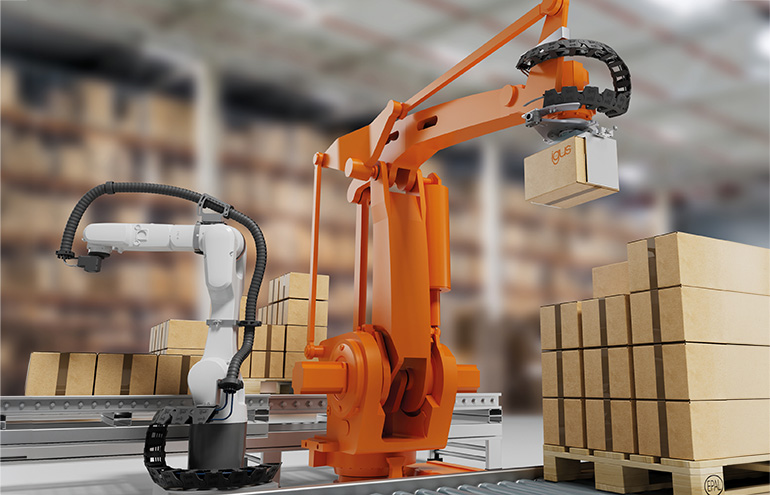
Industrial robots twist, pivot and rotate all day long — and every one of those movements drags cables and hoses along for the ride. Left unmanaged, that bundle snags, kinks and eventually fails. igus reckons its new self-supporting twisterchain energy chain, unveiled on August 3, 2026, is built to keep everything under control even when the robot goes for a full spin.
The headline number here is rotation: the twisterchain handles a rotation angle of over 600°. That’s more than a full turn and a half, which is exactly the kind of range that trips up conventional cable routing on palletizing and handling machines. igus positions the system for two specific spots on a robot’s kinematics — Axis 1, at the base of small industrial robots, and Axis 5, where palletizing and handling robots do most of their twisting.
What makes this version stand out is the self-supporting design. There’s no guide trough or trough system required, so the chain holds its own shape as it moves. That’s a genuine practical win: fewer parts to install, less bulk cluttering the base of the robot, and one less thing to align during commissioning. On Axis 1, the chain can be mounted directly on the floor or on a raised plinth, depending on how the cell is laid out.
Servicing is usually where cable carriers become a headache, and igus has clearly thought about the person holding the wrench. The chain opens on the inner radius, which makes threading cables in far less of a fight than snaking them through a closed loop. Once installed, the cables stay easily accessible for maintenance rather than being buried in the assembly.
Inside, igus includes shelves for separating cables or hoses. It’s a small detail, but keeping data lines away from power lines and pneumatic hoses reduces chafing and interference — the sort of tidy engineering that pays off over thousands of duty cycles.
- Rotation angle: over 600°
- Design: self-supporting, no guide trough required
- Access: opens on the inner radius for cable insertion
- Interior: shelves to separate cables and hoses
- Mounting: floor or raised plinth (Axis 1)
- Target applications: palletizing and handling robots (Axis 5)
The twisterchain slots neatly into igus’s broader push to make cable management for demanding robotics jobs a solved problem rather than a recurring one. Palletizing in particular is a punishing environment — high cycle counts, repetitive rotation, and downtime that costs real money — so a carrier designed to survive that motion without extra hardware is a sensible pitch.
igus hasn’t published pricing yet, and there’s no word on availability beyond the announcement itself. But for anyone wrestling with cables on a rotating robot base, a self-supporting chain that shrugs off 600-plus degrees is worth keeping an eye on.