If you own a telescope, a decent camera, or just a pair of eyes, August 2026 has already handed you one of the busiest weeks in recent astronomical memory. Several headline events stacked up around the same 24 hours, and here’s how they played out.
Perseid meteor shower. Earth’s annual pass through the debris trail of Comet 109P/Swift-Tuttle peaked overnight on Wednesday, August 12, spilling into the early hours of the 13th. The timing was close to ideal: the peak coincided with the new moon, so there was no lunar glare washing out the fainter streaks. The meteors radiate from the constellation Perseus, though they can flash across any part of the sky — a stargazing app was the easiest way to orient yourself.
Total solar eclipse. The month’s showpiece was a total solar eclipse on August 12, with the path of totality clipping slivers of Spain, Portugal, Iceland, and Greenland. For the Iberian Peninsula it was the first total eclipse in more than a century. Madrid sat inside the path of totality, along with Galicia, Asturias, Castile and León, Aragon, Catalonia, Valencia, and the Balearic Islands; the rest of Spain saw a partial eclipse. Totality landed at sunset, putting the darkened Sun low over the horizon for an unusually photogenic scene. NASA and the European Space Agency streamed the event live for everyone outside the path. The one non-negotiable rule stood: never look directly at the Sun without proper protection.
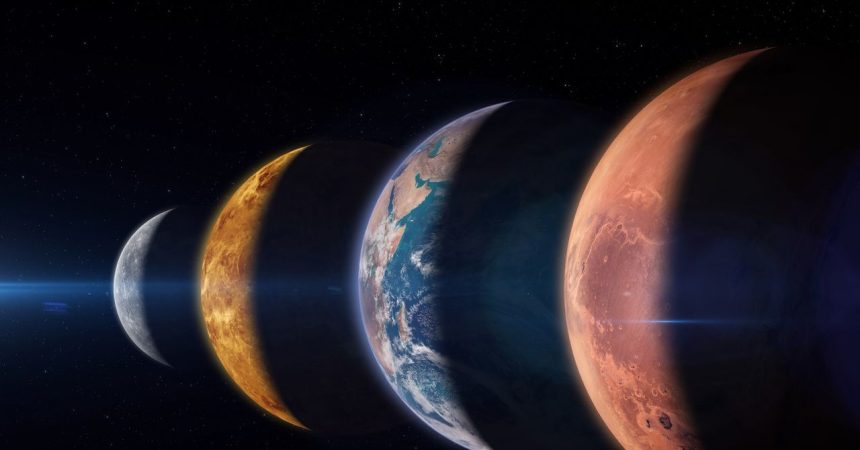
Six-planet alignment. In the pre-dawn hours of August 12, Jupiter, Mercury, Mars, Uranus, Saturn, and Neptune strung themselves into an apparent line across the sky. This one demanded more patience than the Perseids. Under clear skies, Mercury, Mars, and Saturn were visible to the naked eye near the horizon shortly before sunrise, but catching Uranus and Neptune required a telescope.
Partial lunar eclipse. The month closes with a partial lunar eclipse on August 27, covering up to 96 percent of the Moon’s disk. Unlike a solar eclipse, which carves a narrow track across the surface, this one is visible from vast stretches of the planet — practically the entire Americas, from Canada down to Argentina. No eye protection needed here; a dark spot away from light pollution, ideally with a clear horizon, is all it takes. If you’re in the southern hemisphere, the only gear worth packing is a warm jacket.
Miss the eclipse and meteor peak? The lunar eclipse is still ahead, so check your weather app and pick a viewing spot now.