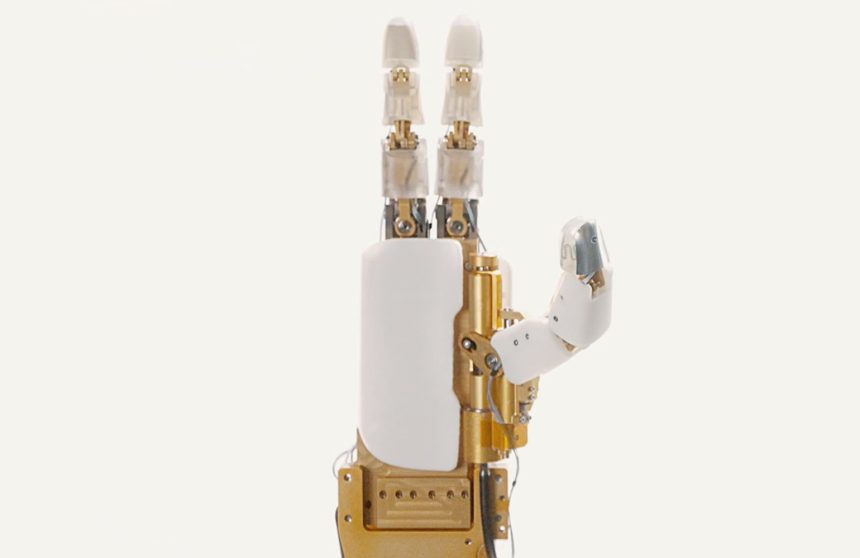
Robots have long been good at brute repetition and terrible at anything requiring finesse. Tacta Systems wants to close that gap with TactaBot, a three-part system built around a robotic hand that learns dexterous skills through demonstration rather than exhaustive programming. The company pulled the wraps off it on July 27, 2026, aiming squarely at high-skilled manufacturing tasks that have stubbornly resisted automation.
The centerpiece is the Tacta Hand, and its cleverness lives in the mechanics. Instead of the bulky electric motors that plague conventional grippers, it relies on a proprietary Fluidic Tendon™ actuation system driving 15 independently actuated joints. That count matters: independent articulation is what separates a hand that can pinch, twist, and manipulate delicate parts from one that merely clamps. The design keeps the actuation compact enough to fit a genuinely human-scale hand, which is precisely what you need when a robot has to slot into workflows originally built for people.
Where TactaBot gets interesting is touch. The hand carries advanced tactile sensors that register a full dynamic range of human contact, from a feather-light 250 pascals all the way up to a firm 700,000 pascals. In practical terms, that spread lets the system feel the difference between resting a fingertip on a fragile component and gripping hard enough to seat a stubborn connector. Force feedback across that range is the ingredient most robotic hands lack, and it’s the reason many can’t be trusted with anything breakable or misaligned.
Then there’s the teaching angle, which is the real pitch. Rather than scripting every motion in code, TactaBot is designed so operators can show it new manual skills, and the robot picks up the technique. That approach mirrors how a human apprentice learns from a seasoned worker on the floor, and it could dramatically shorten deployment times for tasks that vary from station to station.
Tacta describes the product as a three-part system, with the hand as the most visible piece. The company is positioning it not as a lab curiosity but as a working tool for factories that need dexterity at scale — think assembly, fitting, and handling jobs that today still demand human hands.
As for getting your own, patience is required. TactaBot is not yet on sale, and Tacta Systems has not published pricing. The company says the system is scheduled to deploy with manufacturers in early 2027, so the first real-world results should come from industrial partners rather than an open order book.
If the demonstrations hold up on the factory floor, TactaBot could mark a genuine shift — robots that don’t just move parts, but handle them with the kind of touch that used to be exclusively human.