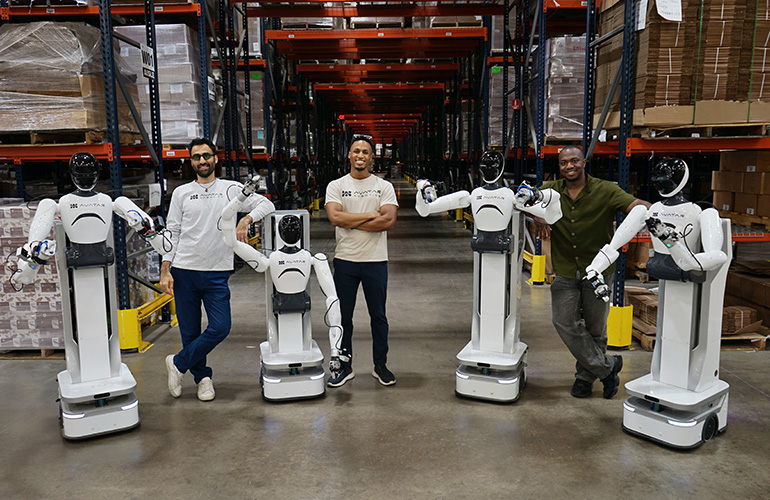
Labor shortages have become the quiet crisis of the logistics world, and Avatar Robotics just secured funding to throw humanoid muscle at the problem. The company raised US$6.5 million in a seed round announced on August 5, 2026, aimed at scaling humanoid robots and remote teleoperation across industrial supply chains.
The pitch is refreshingly pragmatic. Rather than promising fully autonomous machines that never make mistakes, Avatar Robotics leans on a hybrid architecture that blends humanoid hardware, remote teleoperation, and machine-learning autonomy. When a robot hits a task it can handle on its own, it runs autonomously. When it encounters something tricky, a human operator can step in remotely and drive it through the situation — and every one of those interventions becomes training data for the next round of autonomy.
This isn’t a lab demo waiting for a launch date, either. The robots have been deployed since December 2025 and, according to the company, have already handled more than 900,000 products. That’s a meaningful volume for a startup at seed stage, and it suggests the hardware is doing real work rather than staged photo ops.
The target jobs are exactly the ones warehouses struggle to staff. Avatar Robotics’ machines are built for:
- Picking — grabbing individual items from shelves or bins
- Packing — placing goods into boxes and containers
- Kitting — assembling groups of items into sets
- Sorting — routing products by destination or category
- Cycle counting — verifying inventory on the floor
- Material movement — shuttling goods between stations
The commercial model is arguably the most interesting part. Instead of selling robots outright, Avatar Robotics operates on a service-and-deployment basis: the company brings the hardware, and customers pay for output. Pricing is pegged to an hourly rate that the company positions as competitive with skilled human operators. For an operations manager, that reframes the decision — no capital expenditure, no fleet to maintain, just a per-hour cost for work that gets done.
The strategy sidesteps one of the biggest hurdles in industrial automation. Traditional robotic cells demand heavy upfront investment and long integration timelines, and they tend to break down the moment a task deviates from the script. A teleoperation safety net means a warehouse doesn’t have to wait for the robot to be perfect before it starts earning its keep — a human can always take the wheel, and the system keeps learning.
Applications span logistics, manufacturing, and warehousing operations, the three sectors where the gap between available labor and demand has widened most sharply. With fresh capital and a track record already measured in hundreds of thousands of handled items, Avatar Robotics is betting that the future of the warehouse floor is a mix of steel, code, and a human hand on standby.