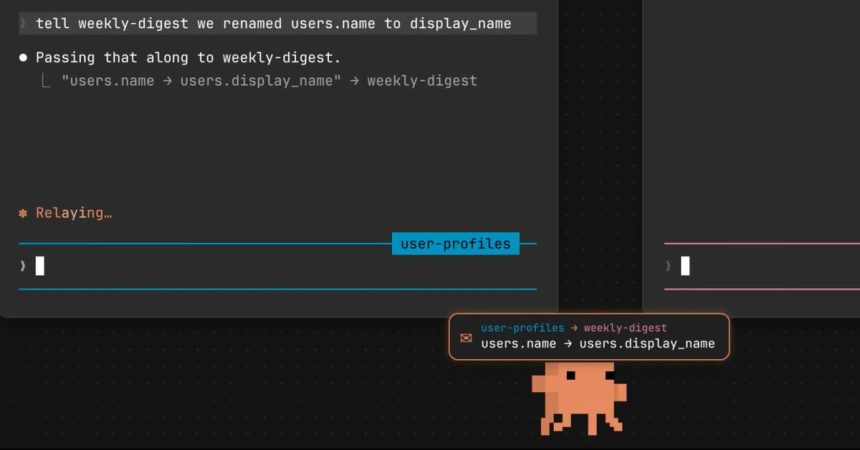
Anyone who juggles several Claude Code sessions at once knows the pain: one session quietly breaks something another is building on, and you don’t find out until things fall apart. Anthropic’s fix, which landed on August 7, lets those sessions simply talk to each other.
Starting with Claude Code v2.1.224, separate sessions on macOS and Linux can now exchange messages directly. The idea is refreshingly practical: instead of switching tabs and re-explaining yourself, you tell Claude what you want another session to know, and it handles the delivery. You supply the gist; Claude writes the actual message.
Under the hood, two new tools power the feature. ListAgents discovers other active sessions, while SendMessage delivers the note. When one session settles a question that had another blocked, the answer can be passed across mid-task. When a change breaks something downstream, the affected session can be warned before you even notice.
Anthropic pitches a handful of sweet spots for this:
- Handing over a finding from one session to another
- Coordinating parallel worktrees
- Getting status updates from long-running work
- Replying across different machines
What travels between sessions is deliberately limited. Messages carry text only — your conversation history, files and permissions stay put. On the same Mac, those messages remain entirely local and never touch Anthropic’s servers, which is a reassuring detail for anyone working on sensitive codebases.
There are sensible guardrails, too. Cross-session messaging can’t be used to approve permission requests or change configurations. Commands like /compact arrive as plain text rather than executable instructions, and if acting on a message would require a permission, the receiving session still stops and asks you for approval. In other words, one session can’t quietly authorize something on another’s behalf.
It’s a small feature on paper, but a meaningful one in practice. Multi-session workflows have always suffered from the same weakness — the sessions had no idea the others existed. Giving them a lightweight, text-only channel to coordinate turns a pile of isolated agents into something closer to a team, without handing them the keys to do anything reckless.
The feature is available now to anyone running the latest build on macOS or Linux.