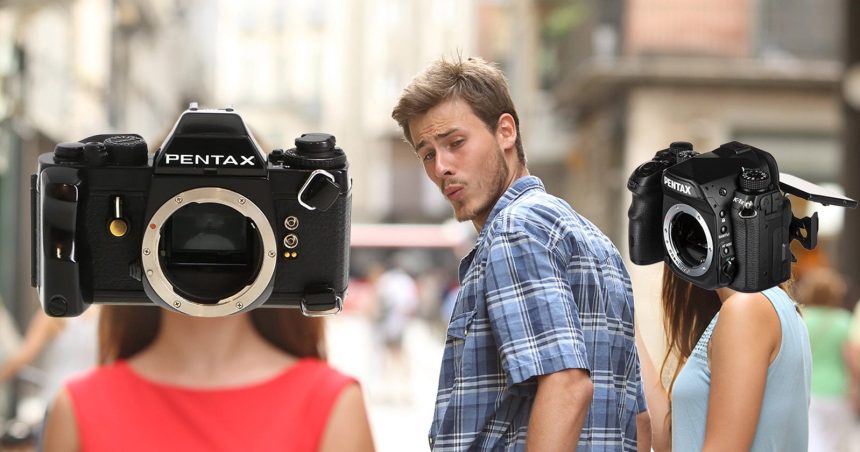
Pentax occupies one of the strangest positions in the camera world. While Canon, Nikon and Sony have all but abandoned the mirror box in favor of mirrorless designs, Pentax is still waving the flag for the DSLR. That’s admirable in a stubborn, contrarian sort of way — but it also raises an awkward question: who exactly is left to buy them?
The short version, according to a recent PetaPixel commentary, is that the appetite for brand-new DSLRs has largely evaporated. The wider market has moved on. Enthusiasts chasing autofocus performance, high-resolution electronic viewfinders and hybrid video capability found what they wanted in mirrorless systems years ago, and they haven’t looked back.
Yet Pentax — and by extension parent company Ricoh — remains publicly committed to the format. Ricoh has repeatedly signalled that it intends to keep the Pentax name alive, and Pentax itself has made no secret of its wish to keep producing optical-viewfinder DSLRs rather than pivoting wholesale to mirrorless like everyone else.
The heart of the argument is straightforward: loyalty to a shrinking niche isn’t the same as a strategy. There is a devoted community that genuinely prefers the DSLR experience — the optical viewfinder that shows the world with zero lag, the mechanical directness, the tactile shooting rhythm. But a passionate minority can only sustain a product line for so long, and simply releasing another familiar body into that niche may not be enough to move the needle.
There are rumors circulating about a new, as-yet-unreleased Pentax DSLR said to be in production, with insider chatter pointing to a possible launch later in 2026. Crucially, though, nothing is official. Pentax and Ricoh have confirmed no model name, no specifications, no pricing and no firm release date. Everything beyond the company’s stated commitment to the format remains speculation.
So what would ‘doing something different’ actually look like? That’s the interesting part. Pentax has form here — the company has never been shy about odd, delightful experiments, from its retro-inspired designs to features aimed squarely at people who love the craft of photography rather than the spec sheet. If it wants a DSLR revival to genuinely land, the thinking goes, it needs to lean into what makes an optical viewfinder camera special in 2026, not just rehash a formula that the rest of the industry quietly retired.
There’s a genuine romance to the idea of a company betting on the road not taken. Film photography’s resurgence proved that ‘obsolete’ technology can find a passionate second life when it’s positioned as an experience rather than a compromise. A DSLR could, in theory, ride that same wave.
But romance doesn’t pay the bills. For now, Pentax fans are left watching, waiting, and hoping that when the next camera does arrive, it brings a reason to exist beyond nostalgia — because doing the same old thing almost certainly won’t cut it.