Physical AI has a connectivity problem. Autonomous mobile robots, self-driving vehicles and computer-vision systems don’t just need bandwidth — they need deterministic, low-latency links that never drop a packet at the wrong moment. Celona thinks the answer is to stop treating wireless as a pile of disconnected networks and start treating it as one fabric.
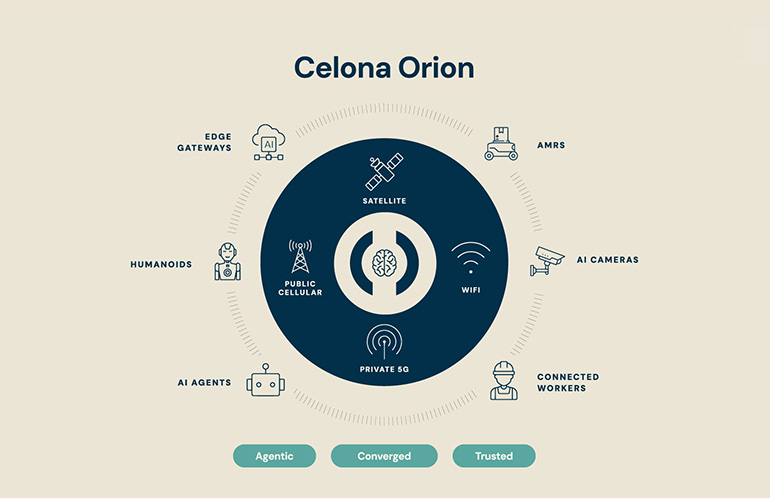
That’s the pitch behind Celona Orion, announced on August 12, 2026 by the Campbell, California private-wireless outfit. Instead of forcing operators to stitch together private 5G here, Wi-Fi there and cellular somewhere else, Orion folds private 5G, Wi-Fi, public cellular and satellite into a single deterministic, secure network. For a warehouse floor crawling with AMRs or a yard full of autonomous vehicles, that means seamless handoff between technologies without the usual duct-tape integration work.
The brains of the operation is Orchestrator AI. Celona has taken its existing cloud-native Celona Orchestrator — previously an operations and management tool — and evolved it into what the company calls an agentic OS for converged wireless. In plain terms, the network is meant to manage itself, making real-time decisions about connectivity so that edge software agents and machines stay online without a human babysitting the radios.
Celona is squarely aiming this at physical AI rather than office Wi-Fi. The target workloads read like a robotics conference agenda:
- Autonomous vehicles (AVs) moving through industrial sites
- Autonomous mobile robots (AMRs) on warehouse and factory floors
- Computer vision systems that can’t tolerate jitter
- Edge software agents running distributed decision-making
Commercially, the platform runs on a unified subscription model that covers both private 5G and Wi-Fi under one roof — a deliberate contrast to buying and licensing each layer separately. Notably, Celona is bundling its Wi-Fi 7 access points at no additional cost alongside 5G radios as part of a multi-year subscription. That’s an aggressive move: Wi-Fi 7 hardware thrown in essentially free is designed to make the 5G side of the deal look like a no-brainer.
The technical logic here is sound. Wi-Fi 7 handles dense, high-throughput indoor coverage cheaply, private 5G delivers wide-area determinism and cellular plus satellite fill the gaps where wired backhaul and hotspots can’t reach. Wrapping all four in a single agentic layer is genuinely useful if a robot can roam from a loading dock to an open yard to a remote site without dropping its control link.
Availability is phased. Orion arrives beginning in Q4 2026, with key capabilities rolling out gradually rather than all at once. No pricing has been disclosed beyond the subscription framing — which, given the included Wi-Fi 7 hardware, will hinge entirely on how Celona structures those multi-year contracts.
Whether “one network for physical AI” is a category or clever marketing, the underlying idea — that robots deserve infrastructure that thinks — is one worth watching.