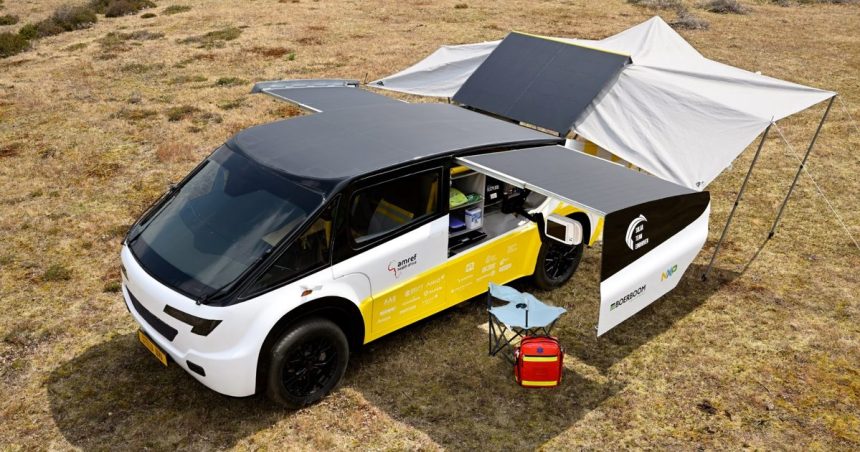
Solar-powered vehicles have spent years stuck in the safe world of university demos and glossy concept reveals. Stella Juva just did something far more convincing: it drove hundreds of miles across rough terrain, hauled a full kit of medical gear, and generated more energy than it consumed while doing it.
Built by Solar Team Eindhoven — a group of 23 students from Eindhoven University of Technology and two other institutions — the two-seat vehicle is billed as the world’s first solar ambulance. But it isn’t designed to blast patients to hospital. The idea flips the usual model: instead of bringing patients to care, it brings care to patients in places where roads are bad and the grid simply doesn’t reach.
In August 2026, the team took Stella Juva to Kenya in partnership with Amref Health Africa. The mission was blunt: could a solar car really cross long distances of hostile terrain and run medical equipment once it arrived? It could. The students drove more than 800 kilometers (about 500 miles) around the country, including a run to an off-grid health clinic in Mosiro, in the Narok region of southwest Kenya. Much of that meant hours on dusty, pothole-riddled clay roads — and the team said the vehicle held up better than expected.
The hardware backs up the ambition. Stella Juva weighs 1,350 kg (around 3,000 lb), tops out at 120 km/h (75 mph), and manages a range of roughly 715 kilometers (440 miles) on a sunny day. A 50-kWh battery is fed by 542 solar cells wrapped across the body, topping up while the vehicle drives. When it stops, expandable panels fold out for extra charging muscle.
Onboard, it carries an X-ray machine, an ultrasound scanner, and a refrigerator for keeping vaccines cold. The key result from the trial: while stationary, the ambulance produced more energy than it used even with every piece of medical equipment running at once. No real patients were treated during testing, but Solar Team Eindhoven and Amref estimated around 200 people could have been cared for over two days.
That matters because the context is stark. Roughly a third of Africans live more than two hours from health services, and unreliable electricity plagues clinics across the continent. A vehicle that generates its own power while reaching places the grid ignores isn’t a novelty — it’s a genuinely useful tool.
Solar Team Eindhoven has been building sustainable vehicles since 2013, and some of its ideas have already leaked into industry; Lightyear, founded by five alumni, has shown a demonstration EV using solar-charging tech developed with Nissan.
Stella Juva remains a prototype, and it’s due to return to the Netherlands after its tests. Funding is the real mountain now. But for once, a solar vehicle earned its stripes on a dirt road instead of a display stand — and that’s the proof-of-concept that actually counts.