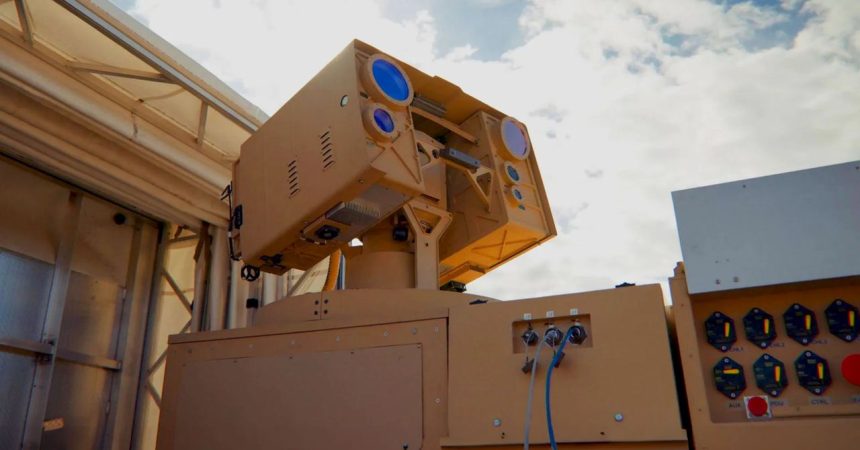
Somewhere over the Rio Grande Valley, three drones went dark this week — not jammed, not shot with bullets, but cooked out of the sky by a beam of concentrated light. The US Army confirmed it used a High-Energy Multipurpose Laser (AMP-HEL) derivative to bring down the aircraft between the night of August 25 and the early morning of August 26, near the US-Mexico border.
The hardware behind the operation is AeroVironment’s Locust Laser Weapon System, a vehicle-mounted platform that represents a new generation of directed-energy weapons. Instead of relying on projectiles, Locust detects, tracks, illuminates and ultimately destroys a target using a single beam that never runs out of ammunition — only electrical power.
Here is how the kill chain actually works:
- 20 kilowatts of output drive an extremely concentrated beam of light
- Sensors, cameras and radar locate and lock onto the target, even while it’s moving
- The system focuses the beam with high precision, then feeds it an additional electrical charge to convert the light into destructive heat
- The drone is damaged or disabled, with the outcome depending on distance, exposure time and the target’s build
The newest Locust units — like those delivered last December — bundle in radar plus command-and-control systems, so the weapon slots into a larger mobile defense network rather than operating as a lone gadget on a truck bed.
The program has moved quickly. AeroVironment handed over its first two functional prototypes in September 2025, followed by two improved systems in December of the same year as the effort expanded. All were configured for vehicle mounting, and the Army fielded them exactly that way.
As for the drones themselves, the details stay murky. The exact operation site hasn’t been disclosed, nor the origin of the aircraft or who was flying them. The mission was run by Joint Task Force Southern Border (JTF-SB), operating under US Northern Command, which said the drones were “posing a physical threat to US military personnel and CBP partners.”
Major General Curtis Taylor, commander of JTF-SB, pointed toward organized crime. “Cartel networks are increasingly employing unmanned aircraft systems to facilitate illicit human smuggling and actively spy on our personnel and law enforcement partners,” he said. “By integrating layered countermeasures alongside advanced directed-energy capabilities like this laser system, we have made it clear that we will not tolerate hostile surveillance.”
The official statement stopped short of naming which specific AMP-HEL variant fired the shots. What’s clear is the direction of travel: cheap, disposable drones are now a serious border-security headache, and lasers offer a tempting answer — near-instant engagement, no reloading, and a cost-per-shot measured in electricity rather than missiles. Locust is one of the first systems to put that promise on wheels.