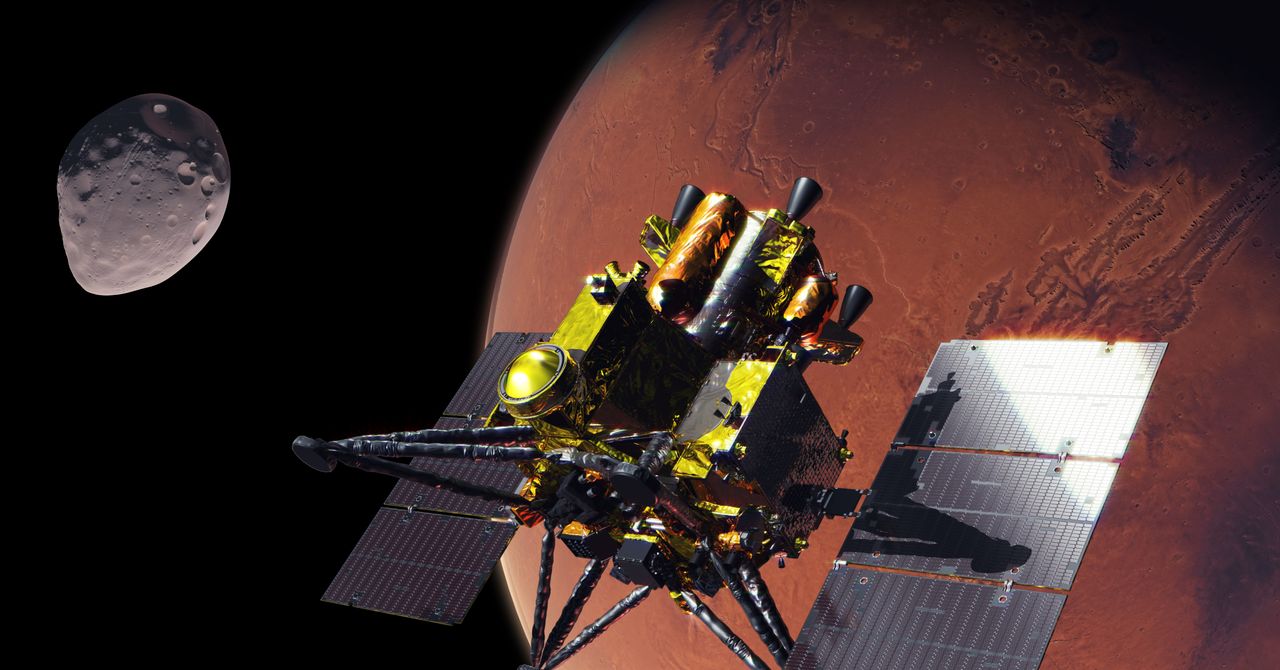
Ten grams of gravel does not sound like much of a haul for a five-year interplanetary mission. But if the Japan Aerospace Exploration Agency’s MMX probe pulls it off, those grams will be the first material ever brought back to Earth from a moon of Mars.
MMX — short for Martian Moons eXploration — is scheduled to lift off on October 20, 2026 at 4:41:03 JST aboard H3 Launch Vehicle flight No.10 (H3 F10) from the Yoshinobu Launch Complex at the JAXA Tanegashima Space Center. JAXA has reserved a backup launch period of October 21, 2026 to November 7, 2026. It is Japan’s first Mars probe launch in 28 years, at a cost of about $345 million US.
Patience is part of the design. The spacecraft needs roughly one year to reach Mars, then spends three years operating in the Martian system, then takes another year to come home. Scientists expect the samples in 2031, with the re-entry capsule recovered in Australia.
The prize is an answer to a stubborn question: where did Phobos and Deimos come from? Either they condensed out of debris thrown up by a massive collision with Mars, or they are outer-solar-system asteroids that got captured. The evidence pulls both ways — the moons are dark, with light-reflecting properties closely resembling water- and carbon-rich asteroids, yet their nearly circular orbits along Mars’ equatorial plane, running with the planet’s rotation, fit the giant impact story far better.
Getting there is a fuel problem. MMX will have a mass of 4,480 kilograms at launch, more than half of it propellant split into three reserves — outbound, exploration, and return. Near Mars the outbound module is jettisoned once its tanks are dry; the exploration module goes after the Deimos flyby.
Then comes the hard part. Phobos has a radius of roughly 11 kilometers, against more than 1,700 kilometers for Earth’s moon, and the lunar descent playbook does not transfer:
- The Moon’s specific gravity is about 300 times that of Phobos, so lunar-style descent logic is useless.
- Phobos’ gravity is about 50 times greater than that of the asteroid Ryugu, where JAXA has landed before — so the prolonged hovering used at Ryugu would burn far too much fuel.
- Radio signals take up to 20 minutes, meaning the probe must decide on and execute descent, landing and takeoff on its own.
High-precision autonomous navigation fills the gap. On the way down, MMX matches the terrain below against topographic data on Phobos’ craters to steer toward its target. Under an altitude of 300 meters it starts watching for elevation changes, tags significant discrepancies as hazardous, and can retarget, or abort and climb back up.
It will not arrive blind. Just ahead of the main landing, the IDEFIX rover, jointly developed by the French and German space agencies, is deployed for about 100 days of independent exploration — a scout sent to make the landing safer.
On the surface, a robotic arm drills cylindrical tubes into the regolith, while a device originally developed by NASA uses a stream of nitrogen gas to lift fine particles off the very top layer of dust. The bonus: meteorite strikes have been blasting material off Mars and dusting its moons for eons, so researchers expect about 0.1 percent of the haul to be Martian debris. Whichever way the origin debate falls, MMX should come back carrying a piece of the planet itself.