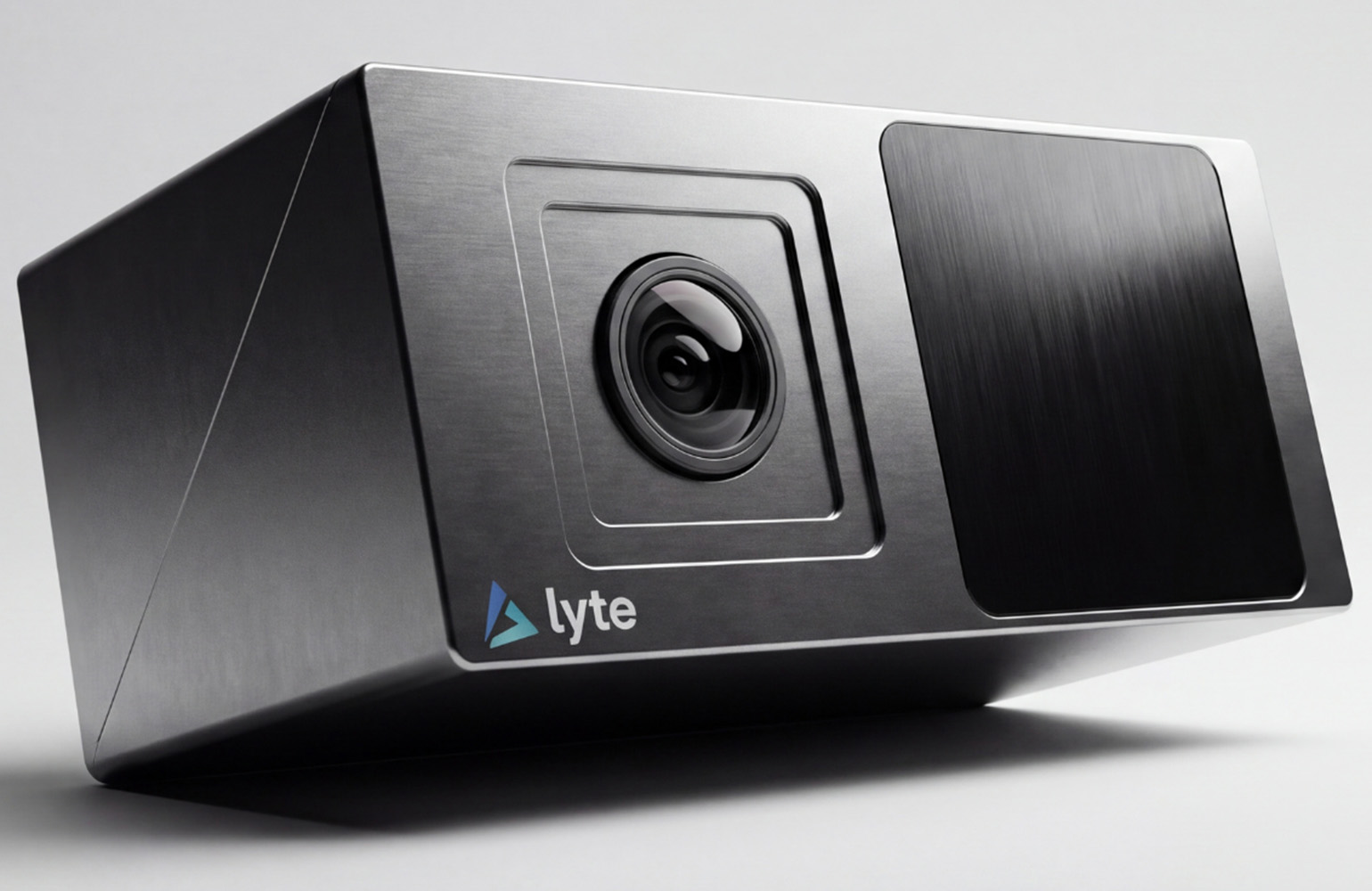
Most robotics startups burn their funding on models. Lyte AI is spending it on the layer underneath — the sensors and silicon that decide what a model gets to think about in the first place. On September 2, 2026, the Sunnyvale, California company announced a $165 million Series C at a $1.6 billion post-money valuation, led by Maverick Silicon.
It is the second round Lyte has closed in 2026. Fidelity Management & Research Company, which led the Series B, came back in, joined by Atreides Management, Key1 Capital and Ora Global (formerly Exor Ventures), plus other new and existing backers. Total funding now stands at $272 million, including the $107 million announced in January 2026, when Lyte stepped out of stealth. Andrew Homan, managing partner at Maverick Silicon, joins the board.
The pitch is blunt, and CEO and co-founder Alexander Shpunt makes it without hedging: “Physical AI has a sensing problem before it has a model problem. A robot cannot act safely on data that does not faithfully describe the world.” The argument is that today’s machines are assembled from off-the-shelf parts that were never designed to work together — a stack that introduces latency, calibration drift and, ultimately, data that quietly lies about the scene.
Lyte’s answer is LyteVision, an integrated perception platform the company says it controls “from the transistor up.” It pairs custom silicon processors with a multimodal sensor block that fuses three streams into one synchronized system:
- 4D coherent vision — depth plus native motion measurement
- High-resolution RGB imaging for color and texture
- An inertial measurement unit (IMU) for the platform’s own movement
The distinction Lyte keeps drawing is between measuring motion and reconstructing it. A conventional camera rig infers velocity after the fact, in software, by comparing frames — which is exactly where errors and lag creep in. Lyte’s silicon is built to capture motion natively at the edge, alongside spatial and color data, and hand the robot a description of the world rather than an estimate of it. On top of the sensing blocks sits LyteGalaxy, the company’s unified spatial intelligence platform.
The pedigree explains a lot about why investors bit. Lyte was founded in 2021 by three former Apple engineers — Shpunt, Arman Hajati and Yuval Gerson — whose work fed into Face ID. Shpunt co-founded PrimeSense, the 3D-sensing outfit behind Microsoft’s Kinect that Apple acquired in 2013. Chipmaking veteran Avigdor Willenz serves as chairman.
The money goes toward scaling production of the sensing silicon and sensor platform, advancing the AI and perception software, and widening deployments. Lyte says LyteVision is already in the field with robotics customers across inspection, logistics and manufacturing, and it lists autonomous mobile robots, robot arms, last-mile delivery machines, quadrupeds, robotaxis and humanoids as targets. Making a robot smart is one problem. Making it see is the one Lyte wants to own.