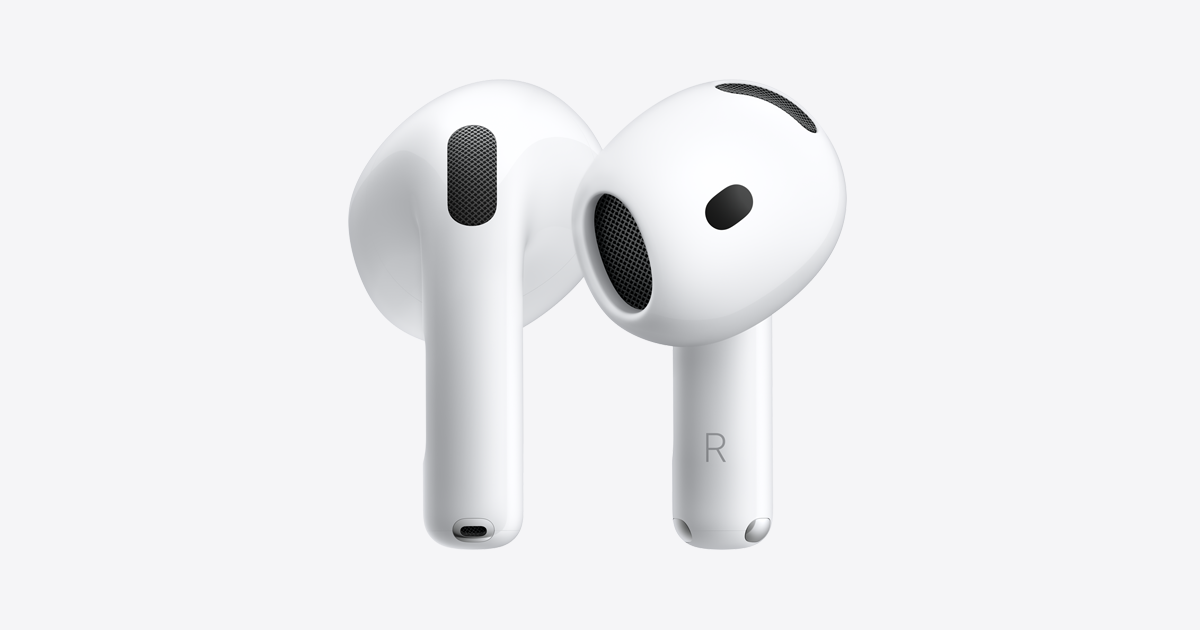
Active noise cancellation is no longer the upsell in Apple’s entry-level earbuds. The AirPods 5 were unveiled on September 9, 2026 in two variants, and this time both of them cancel noise — a tidier arrangement than the AirPods 4 and AirPods 4 with ANC pairing that launched in September 2024.
The standard AirPods 5 cost £119 / $129, and the AirPods 5 with wireless charging case cost £139 / $149. Pre-orders opened on September 9, 2026, and both models go on sale on September 18, 2026.
Neither model uses eartips, so Apple is still working within the constraints of an open-ear fit. Its answer is an updated open-ear design built around a new multi-port acoustic architecture and a next-generation adaptive EQ, which the company says delivers “richer, more detailed sound across a wider range of ear geometries” — a pointed nod to the fact that a seal-free bud lives or dies by the shape of your ear. Personalised spatial audio is billed as more immersive and dynamic as a result.
The noise cancelling story leans on the same combination. Apple pairs the redesigned hardware with improved “computational audio algorithms” and claims 50 per cent more noise reduction than the previous generation, which it calls “the best ANC in an open ear design”. Transparency mode has been reworked to sound more “natural”. Durability moves up too, with an IP57 rating covering rain, sweat and dust.
The two models split along familiar lines:
- AirPods 5 — up to 4 hours of listening with ANC on a single charge, up to 20 hours with the included USB-C charging case. Wired charging only.
- AirPods 5 with wireless charging case — up to 5 hours with ANC on a single charge, up to 22 hours with the case, plus on-stem volume controls borrowed from the AirPods Pro 3. The case works with Qi and Apple Watch chargers.
Both run on Apple’s H2 headphone chip. Both also gain live translation, a feature previously reserved for the flagship Pro 3 and Pro 2, and both can be used hands-free with the new, more conversational Siri AI. The usual iOS furniture is present as well: spatial audio, conversation awareness, adaptive audio and Find My.
What that adds up to is a cleaner line-up. Buyers no longer have to decide whether noise cancelling is worth a separate SKU; the choice is now simply how much battery, whether stem swipes for volume matter, and whether the case should charge without a cable. At $129 for the entry model, the extra $20 for the step-up version buys an hour of listening, two hours of case reserve, volume gestures and Qi support — a decision most people will make in about five seconds.
Earlier on GismoLand: AirPods 5. Apple’s entry-level buds split into two flavors.