Three months before the towers fell, a shortwave radio host in Arizona told his audience that the whole bin Laden threat was a fraud. On June 28, 2001, Milton William “Bill” Cooper went on air after watching a CNN report and claimed a reporter had walked into Osama bin Laden’s hideout and come out with a warning of an attack on the United States and Israel within three weeks.
Cooper had the story half right. A journalist had reached al Qaeda’s inner circle in the mountains near Kandahar, Afghanistan, but he worked for the Middle Eastern broadcaster MBC, and he had interviewed the group’s military chief rather than its leader. “In the coming weeks, there will be a big surprise; we are going to hit American and Israeli installations,” Mohammed Atif told correspondent Baker Atyani. To Cooper, the only possible readings were incompetence or a lie. “The CIA created Osama bin Laden,” he told listeners, describing what would later be called a false flag.
What made Cooper matter was distribution. His 1991 book Behold a Pale Horse became an underground bestseller, and in January 1993 he started broadcasting on WWCR, World Wide Christian Radio. A 100,000-watt signal carried him from his Arizona home across huge swaths of the country, years before anyone talked about algorithmic reach. Two listeners became infamous. One was Timothy McVeigh, who drove to Arizona in the spring of 1995 and then bombed the Alfred P. Murrah Federal Building, killing 168 people and injuring nearly 700. The other was Alex Jones, an Austin public-access host who had raised money to rebuild the church at the Branch Davidian compound in Waco, where a 51-day siege ended in 1993 with 75 fatalities.
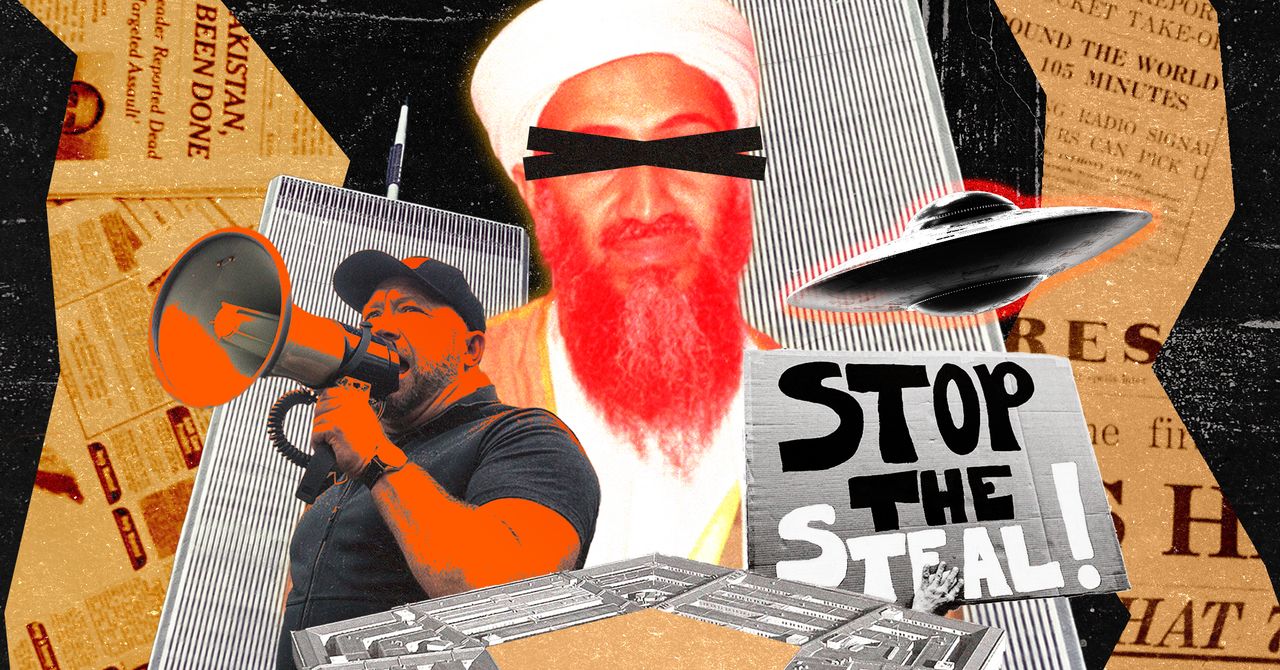
Jones lost his KJFK-FM slot in December 1999 because his conspiracism scared off sponsors. He moved to a domain instead: Infowars.com. On September 11, 2001, broadcasting online and on about 100 syndicated stations, he made the call that defined the next quarter century. “I went on the air and said, ‘Those were controlled demolitions,’” he later told Rolling Stone. Cooper, who titled a September 26, 2001 show “Alex Jones—Liar,” did not live to see it. In November 2001 he shot a sheriff’s deputy in the head during an arrest attempt and was killed in the return fire.
The 9/11 Truth movement that followed bundled together claims that United Airlines Flight 93 had been downed by US fighters, that the Pentagon had been struck by a missile rather than a plane, and that the World Trade Centers had been brought down by space weapons. The 9/11 Commission documented the impossibility of several in unusual detail. Popular Mechanics ran a debunking special issue, later expanded into a book with a foreword by Senator John McCain.
None of it worked. Loose Change, arguably the first viral online documentary, spread through Google Video and the early years of YouTube, with Jones credited as an executive producer on one version. A Zogby poll in May 2006 found that 42 percent of Americans believed the government and the 9/11 Commission had concealed or refused to investigate critical evidence.
Garrett M. Graff traces that arc in an essay published by WIRED on September 11, 2026. The uncomfortable part is how little the machinery changed. Cheap transmission, a charismatic host and an audience primed to distrust official accounts were enough on shortwave, and the internet only lowered the cost of entry.