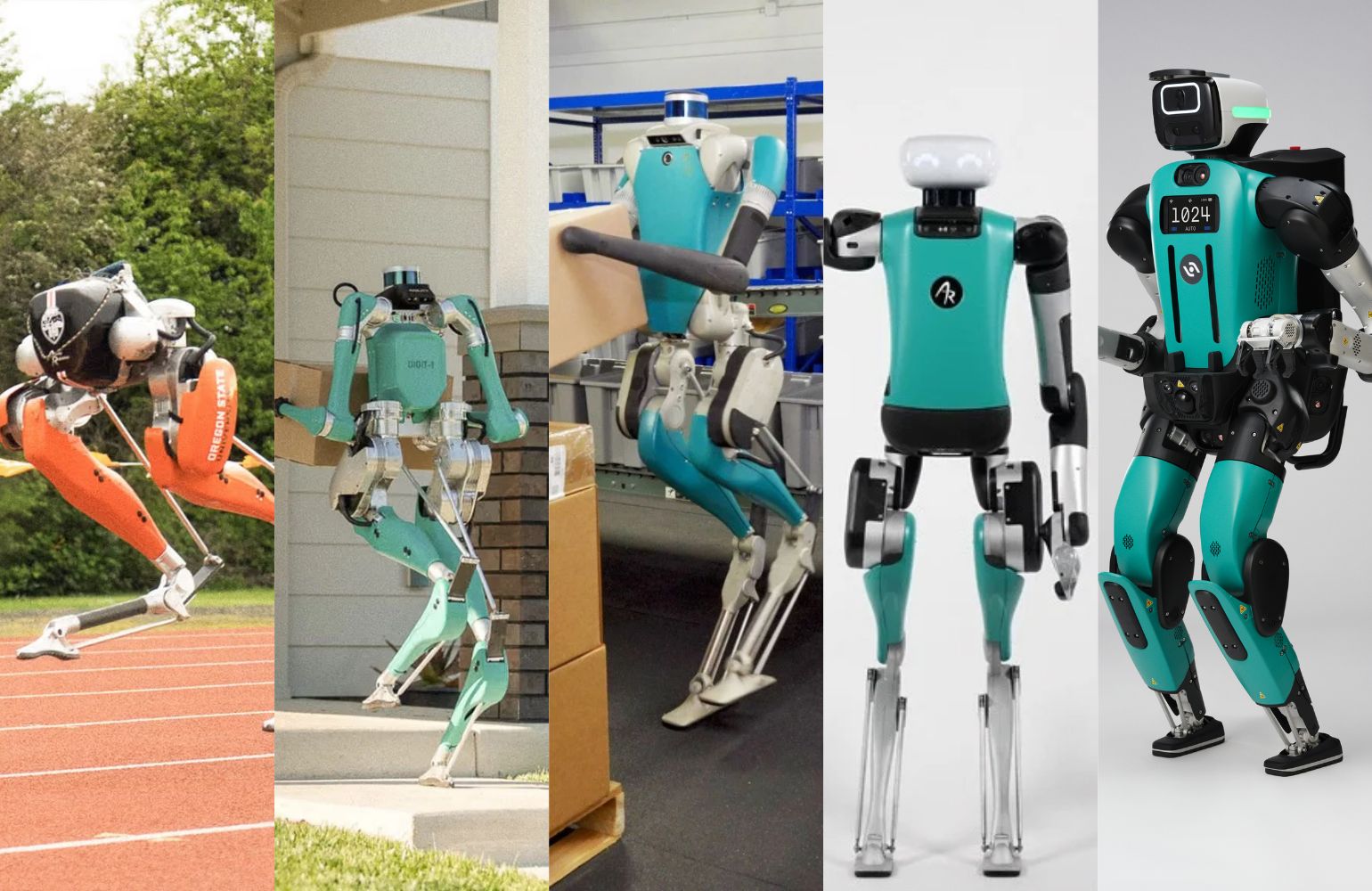
The humanoid Agility Robotics unveiled on September 15, 2026 began as an ostrich-shaped runner. On September 16, 2026, The Robot Report’s Brianna Wessling traced that path, from Cassie through five versions of Digit. Each version was pushed a little further away from a lab demo and toward work in warehouses and factories.
The company has now been around for over 10 years. It started in Oregon State University’s Dynamic Robotics Lab and has grown to over 400 employees in three offices, with a factory that can build 10,000 robots a year.
Cassie: built to run
Cassie arrived in 2016, and its bird-like legs were a deliberate choice. “Ostriches can run 40 miles an hour, and keep going all day long, so we arrived at that configuration because we were trying to achieve that same goal,” said Jonathan Hurst, Agility’s co-founder and chief robot officer. That goal led to a record in 2022: at OSU’s Whyte Track and Field Center, Cassie ran 100 meters in 24.73 seconds, earning the Guinness World Record for the fastest 100 m by a bipedal robot.
Digit: from research robot to paid work
- Digit 1 (2017) was a research platform from the company’s proof-of-concept years. It put Agility into the humanoid market early.
- Digit 3 (2019) was Agility’s first commercial humanoid. It could pick up and stack boxes weighing up to 40 lb (18 kg), and it was pitched for warehouse stacking and for carrying parcels to customers’ front doors. Ford bought the first two production units.
- Digit 4 (2023) was the last Digit with bird-like legs and the last robot of the proof-of-concept years. New end effectors helped it reach, pull, pick and place items in e-commerce and shipping. It went to work for Toyota Motor Manufacturing Canada Inc., GXO Logistics, Schaeffler, Amazon and others. “We started deploying the robots and showing that it can move boxes, it can deliver packages to the front door, it can move totes, it can move bins, it can do all of this stuff,” Hurst said.
Digit 5: new legs, and no safety cage
Digit 5 drops the ostrich knees for human-style legs and gets longer battery life. It is meant to work near people without a fenced-off zone: it keeps judging the risk around it and slows down or stops when it needs to. Agility’s own specs list a height of 5’11” (1.81 m), a weight of 284 lb. (129 kg), a payload of up to 50 lb. (22.7 kg), a 90-minute battery, a 9-minute charge and a 10:1 run-to-charge ratio. Agility says early access should come in the first half of 2027, with general availability expected by the end of 2027. The company also says Digit 5 is still in development, so its specs may change.
Hurst says the new shape favors strength over speed, because that is what logistics and manufacturing sites need. “This is where the engineering took us. Future configurations may look different depending on the requirements.” He also sees the robot’s firsts as a step toward the home: “Being the first commercially deployed humanoid robot, and being the first functionally safe humanoid robot, those are important steps on getting to the home, and getting robots to be part of everyday life.”
Agility is also planning to go public by merging with Churchill Capital Corp. XI, a SPAC, in a deal that values the company at $2.5 billion. Hurst is already looking a long way ahead: “Twenty or thirty years from now, we’ll have robots in our homes. It’ll be a natural question to look back and say, ‘What did the first humanoid robots look like?'”
Earlier on GismoLand: Agility Robotics Digit 5. A taller humanoid built to work beside people and Agility Robotics. The Digit maker walks toward Wall Street.