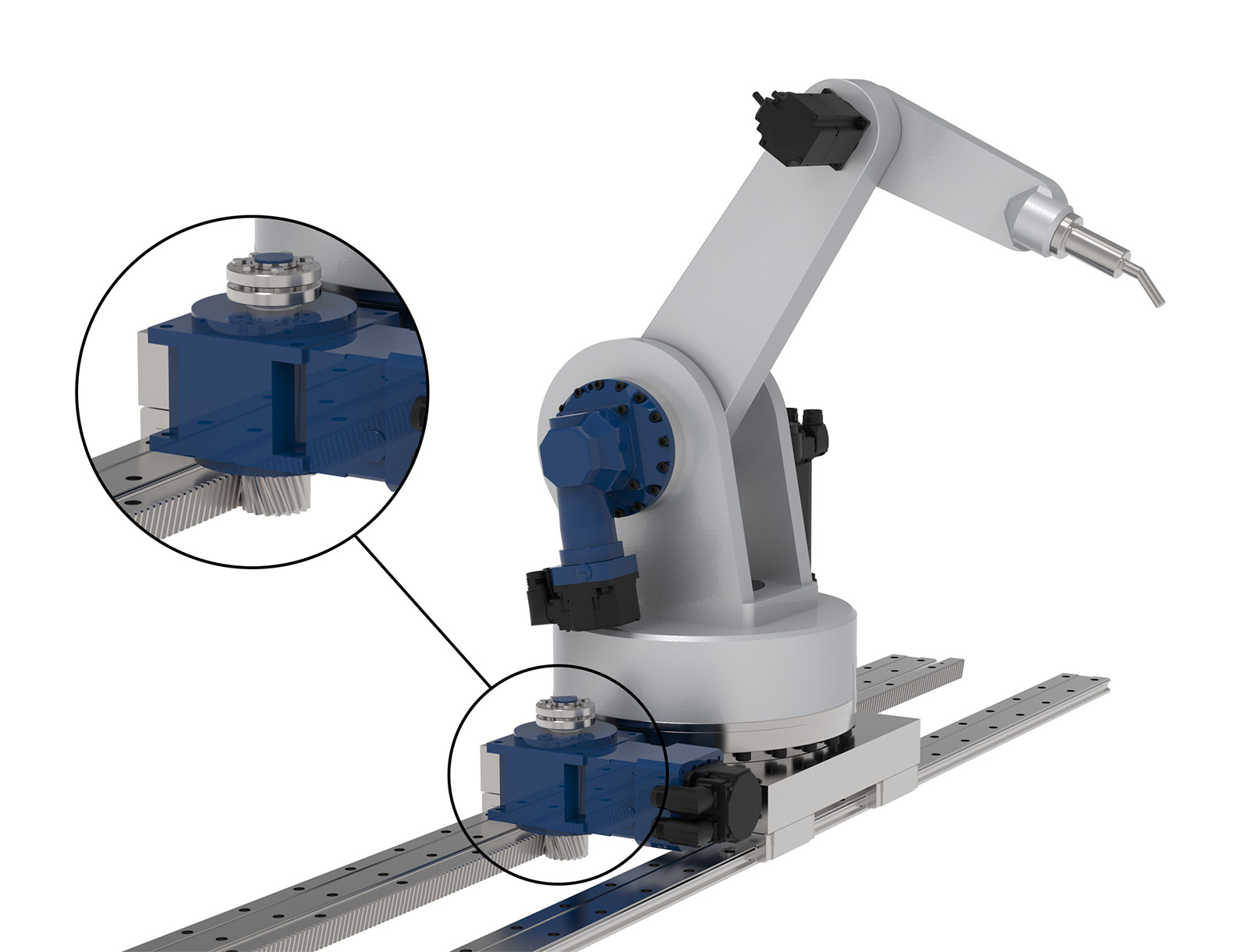
Pull a tape measure out a few inches and the blade stays rigid. Keep pulling and it starts to wobble, then buckles. Machine builders run into the same problem when a robot has to travel along a gantry, a plasma table or a seventh axis. A technical piece in The Robot Report, published on September 17, 2026 and sponsored by US gear reducer maker GAM, compares the three usual ways to get precise straight-line motion. Its answer: past a certain length, the humble rack and pinion is usually the right call.
Three ways to move in a straight line
- Rack and pinion: a rotating gear (the pinion) meshes with a toothed bar (the rack). Either the rack moves past a fixed pinion, or the pinion assembly runs along a fixed rack.
- Ball screw: a precision threaded rod with a nut riding on it. Spin the rod and the nut moves; hold the nut and the rod moves instead.
- Linear motor: in effect an electric motor cut open and laid flat, where the magnetic interaction pushes the load along under a servo controller.
Where the ball screw turns into a jump rope
Over short distances, ball screws hold their own and can even offer higher precision than rack and pinion. Their layout may also suit some machine designs better. The trouble starts at a length of around 2-3 meters, depending on the size of the screw. “As you get into longer distances with ball screws, there’s a phenomenon called whip,” explained Matt Ruggles, senior design engineer at GAM. “Basically, the ball screw turns into a jump rope,” causing premature wear, vibration and sometimes catastrophic failure.
A rack has no such limit. According to Ruggles, rack and pinion “can basically scale infinitely”: you cut a piece of rack shorter or join several pieces together for a much longer travel.
Linear motors: fast, precise, and expensive to stretch
Linear motors are faster and give highly precise control. But they rely on magnetic flux, so stiffness is harder to manage, and the magnets cause trouble of their own. Ruggles recalls installers whose keys got magnetized in their pockets, and machines that attract chips and other debris as they run. Extending a linear motor also costs much more per meter, because the permanent magnets and electromagnets are expensive compared with another section of rack. On top of that, a linear motor needs constant power just to hold position.
A rack and pinion isn’t magnetized. It holds position as soon as the motor stops, and the motor’s built-in brake does the rest without drawing power. “You do have to buy the rack and pinion and usually a gearbox and a motor, but that combined cost is usually less than the linear motor implementation,” Ruggles said. He added that the result is a stiffer system with higher feed forces for the cost, package size and power consumption.
The clean room exception
Rack and pinion does have one weak spot: clean rooms. The gear teeth need lubrication, which means grease exposed to the air. Covers, seals and the right lubricant can help, but they add complexity. Ball screws have the same issue, though bellows can protect them. Linear motors have no exposed moving parts, which makes them the best fit for medical and semiconductor manufacturing.
What GAM offers
GAM sells rack in standard one-meter sticks that can be chained together, and it can also cut rack shorter. Longer sticks are available on special order. On its website, the company lists helical rack stocked in 1-meter lengths, mod 1.5 – 4, and Q6 and Q10, plus pinions that mount to GAM gearboxes and a lubrication system. Target applications include robot 7th axis, plasma cutting machines, machine tending and material handling systems. Ruggles’s closing advice applies to every option: install carefully and precisely, because if you “slap things together, you might have problems.”