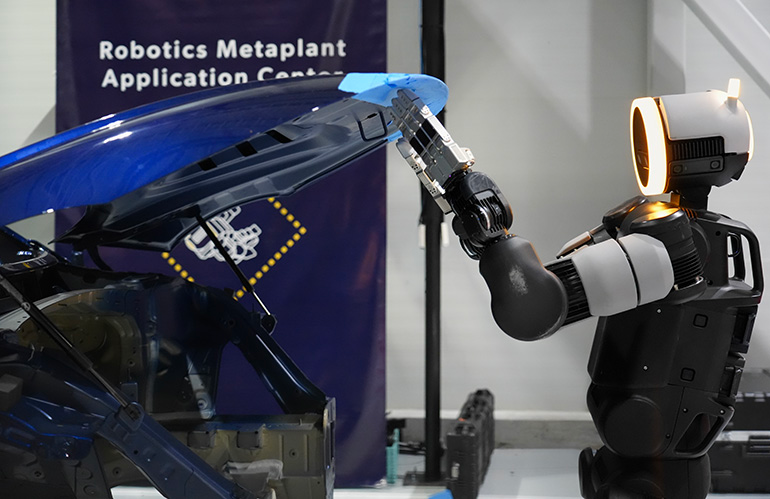
Atlas has moved past the stage of short trial deployments. Boston Dynamics has opened the Robotics Metaplant Application Center (RMAC) at Hyundai Motor Group Metaplant America near Savannah, Georgia. It is a permanent testbed and training center where Atlas humanoids learn real automotive manufacturing work before they go out onto the factory floor. The Robot Report covered the opening on September 21, 2026.
Zack Jackowski, chief product and technology officer at Boston Dynamics, calls RMAC a “Robot Behavior Factory”. The facility uses real parts, fixtures and workcells to produce varied, high-quality data for training robot behaviors. He contrasted it with Atlas’s earlier trials at Hyundai: “The previous trials were time-boxed deployments focused on lessons needed to design our scaled-up presence.” RMAC, by contrast, is “a permanent facility that’s focused on both data collection and application testing that operates in strong coordination with the auto plant.”
How Atlas learns
The humanoids learn from three data sources:
- teleoperation, where human operators guide the robot through tasks;
- reinforcement learning in simulation;
- Universal Manipulation Interface (UMI) devices.
The first curriculum covers the logistics and sequencing of automotive parts before assembly. Atlas has to take parts out of their shipping packaging, put them into cubbies in the right order and handle complex surfaces directly. It also has to respect grasping requirements, which means keeping its hands off cosmetic or fragile areas. Large, awkwardly weighted items need bimanual manipulation, with both hands working together. It sounds mundane, but this is exactly the variable, fiddly work that fixed automation handles poorly.
Jackowski says the work so far has validated the hardware: “The biggest thing we’ve been finding is actually that the design assumptions we made for the production version of Atlas have been very close to right on.”
The robot doing the work
The production Atlas was unveiled on January 5, 2026, and Boston Dynamics said then that the first fleets would go to Hyundai’s RMAC. The official product page lists these specs:
- 56 degrees of freedom;
- height of 1.9 m (6.2 ft) and weight of 90 kg (198 lbs);
- lift capacity of 50 kg (110 lbs) instant and 30 kg (66 lbs) sustained;
- reach of 2.3 m (7.5 ft);
- 4 hours of battery life, with self-swappable batteries for continuous operation;
- IP67 rating and an operating range of -20° to 40°C (-4° to 104°F).
Scaling up
The current RMAC is only the starting point. In 2027, operations are due to move into a new building that will make the center about 10 times larger. Boston Dynamics plans to expand Atlas into component assembly by 2030. Hyundai’s wider plan is to deploy 25,000 Atlas units across Hyundai Motor and Kia plants worldwide. It also plans a U.S. factory able to build 30,000 robots a year by 2028.
“Together with Hyundai Motor Group, we are pioneering physical AI at enterprise scale,” Jackowski said. RMAC is where that claim will be tested, one sequenced part at a time.
Earlier on GismoLand: Boston Dynamics Atlas. Robots take to the pitch at the FIFA World Cup.