The 2026 FIFA World Cup didn’t just deliver upsets on the field — it also became an unlikely stage for two of the most advanced legged robots on the planet. Boston Dynamics, in partnership with Hyundai, brought both the Atlas humanoid and the Spot quadruped to the tournament, though in very different roles.
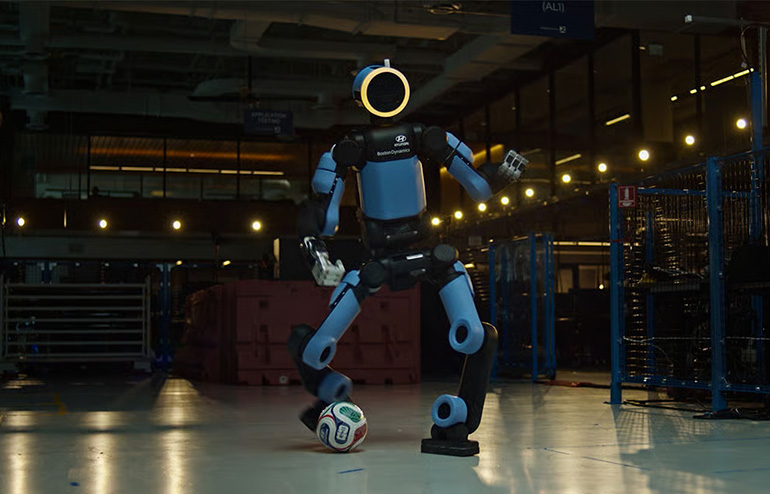
On July 5, 2026, during the Brazil vs. Norway Round of 16 clash at New York/New Jersey Stadium, the six-foot Atlas humanoid stepped into the spotlight. This wasn’t a lab demo shuffling across a mat — Atlas walked, pulled off goal celebrations, and handed objects to onlookers. For a robot that spent years primarily doing backflips in viral clips, learning footwork worthy of a World Cup crowd marks a genuine leap toward practical, human-scale dexterity.
The version on show was the production Atlas, first introduced at CES 2026 back in January. It’s a fully electric machine, driven by custom actuators built around planetary roller screws and high-density neodymium magnets — the kind of hardware that lets it move with speed and precision that older hydraulic designs simply couldn’t match.
Getting your hands on one, however, is another matter. Pricing hasn’t been publicly confirmed by Boston Dynamics, though estimates place Atlas somewhere between roughly $320,000 and $420,000. And even if you have the cash, the queue is long: the entire 2026 production run is already spoken for, committed to Hyundai’s Robotics Metaplant Application Center and Google DeepMind. Broader commercial availability isn’t expected until 2027.
While Atlas grabbed the headlines, its four-legged sibling Spot has been quietly doing the less glamorous work. Spot units have been deployed for security and asset protection at select World Cup venues across the United States, Canada, and Mexico. These aren’t showpieces — they’re patrol units.
The version at work is Spot 5.1, released earlier in 2026 with a sharpened focus on security applications. Its sensor suite is built for the job:
- 360-degree camera for full situational awareness
- 4K high-definition thermal imaging to spot heat signatures in low visibility
- Lidar for precise mapping and navigation around crowds and infrastructure
The pairing tells a neat story about where Boston Dynamics is heading. Atlas represents the flashy, future-facing side of humanoid robotics — the machine that captures imaginations and, eventually, factory floors. Spot is the here-and-now workhorse, already earning its keep in real-world deployments where reliability matters more than crowd-pleasing tricks.
For a tournament watched by billions, it’s a savvy showcase. Millions of eyes got a look at what legged robots can actually do outside a controlled environment — one dancing for the cameras, the other keeping watch in the background. Whether that’s a glimpse of stadium security’s future or just a memorable sideshow, Boston Dynamics has made its point on the world’s biggest sporting stage.