If you blinked, you missed it. The AYANEO Pocket Micro 2 went on sale on June 26, 2026, and every configuration sold out almost immediately. So consider this less a buying guide and more a postmortem on a gadget that buyers clearly wanted very badly.
Announced on June 15, the Pocket Micro 2 is a pint-sized Android handheld built around a familiar but capable engine: the Snapdragon 865. It isn’t bleeding-edge silicon in 2026, but paired with a featherweight Android OS and a small screen, it’s more than enough to chew through emulation and a healthy catalogue of Android titles.
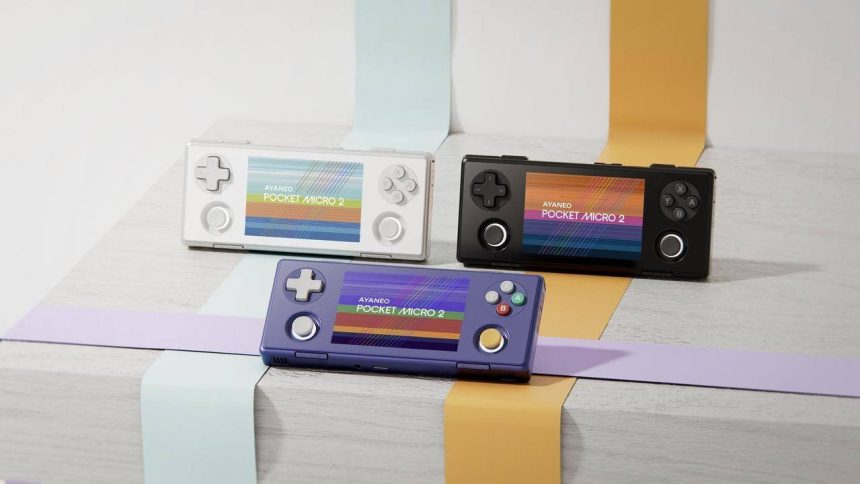
That screen, by the way, is the whole point of the “Micro” branding. You get a 3.5-inch, 960×640 LCD — compact enough to make this thing genuinely pocketable, while still leaving room for proper controls. AYANEO didn’t skimp there either: the unit packs recessed dual TMR joysticks alongside a larger D-Pad and bigger ABXY keys, which should make the cramped form factor feel less like a toy and more like a serious portable.
Connectivity is surprisingly modern for a device this size. There’s a 3.5mm headphone jack for the wired-audio holdouts, plus Bluetooth 5.1 and Wi-Fi 6 to keep things wireless and quick. Keeping the lights on is a 3,950mAh battery, a respectable cell given the modest display and efficient chipset.
On the configuration front, AYANEO kept it simple:
- 6GB RAM / 128GB storage — US$269
- 8GB RAM / 256GB storage — US$309
- 8GB RAM / 256GB storage, Stardust Purple limited edition — US$339
All three prices arrived with a US$30 launch discount baked in, which almost certainly helped fuel the frenzy. Storage is expandable via microSD card across the board, so even the entry-level 128GB model isn’t a dead end for ROM hoarders and offline libraries.
The takeaway? AYANEO has carved out a reputation for niche handhelds that sell out fast, and the Pocket Micro 2 just reinforced it. With a proven Snapdragon 865, thoughtful controls, that ultra-portable 3.5-inch display and an aggressive starting price of US$269, demand clearly outstripped supply. If you were hoping to grab one at launch, you weren’t alone — and that was precisely the problem.