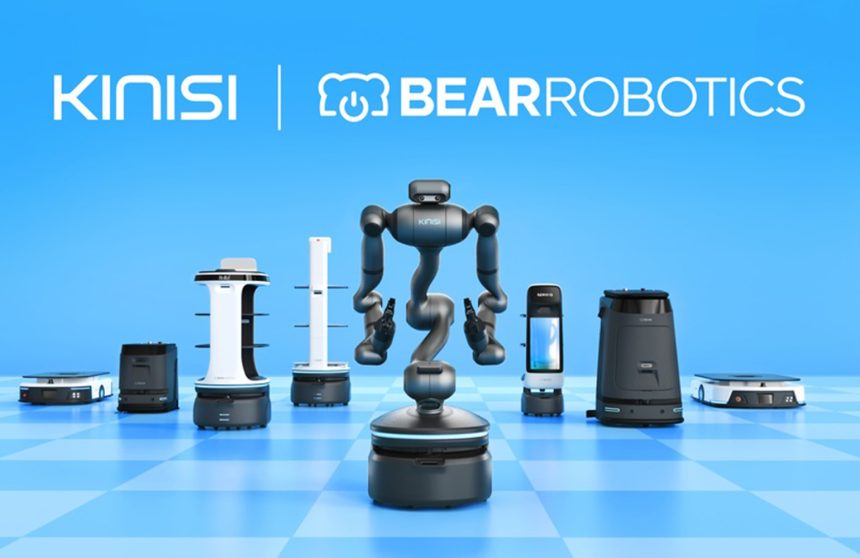
Service-robot maker Bear Robotics has reached for a heftier slice of the humanoid market, agreeing to acquire UK-and-US startup Kinisi Robotics. The deal folds Kinisi’s hardware, its Bristol-based engineering team, and its physical AI know-how into Bear’s broader robotics push.
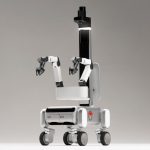
The headline asset is the Kinisi KR1, a wheeled humanoid robot built to pick, place, sort and shuttle objects around the kinds of messy, fast-moving spaces where automation usually struggles — logistics floors, industrial sites and hospitality settings. Rather than chasing a walking biped, Kinisi parked its humanoid torso on a wheeled base, a pragmatic choice that trades dramatic two-legged locomotion for stability and efficiency on flat working surfaces.
What Bear is really buying, though, is the brain behind the arms. Kinisi’s stack centers on proprietary manipulation models, including a vision-language-action model and a robot foundation model. Underneath that sit AI building blocks spanning imitation learning, reinforcement learning, agentic task control and computer vision — the unglamorous plumbing that lets a robot watch, learn and then improvise its way through real-world tasks instead of running rigid scripts.
That combination is the heart of so-called physical AI: software that doesn’t just recognize the world but acts on it through hands and grippers. It’s a notoriously hard problem, since grasping a randomly placed parcel or stacking dishes demands far more nuance than steering a wheeled tray robot between tables.
Kinisi is a young outfit. Founded in 2024 by Brennand Pierce, it operates out of headquarters in New York, US, and Bristol, UK, with a focus on humanoid robots and manipulation technology. Pulling that team and its IP under one roof gives Bear a manipulation-focused engineering core to complement its existing service-robotics business.
The acquisition was announced on June 22, 2026, and the two companies expected to close the transaction in the coming days. Financial terms were not disclosed — unsurprising for a B2B robotics deal, where the KR1 is sold into commercial operations rather than carrying a consumer price tag.
The strategic logic is straightforward. The robotics industry is splitting into two camps: companies that can move autonomously through a space, and companies that can actually manipulate objects within it. Bear has plenty of experience with the former through its service fleets; Kinisi brings the latter. Bolting the two together is a bet that the next wave of commercially useful robots will need both navigation and dexterous hands working in concert.
For now, the KR1 remains a workhorse aimed at warehouses, factories and hotels rather than living rooms. But the deal is a clear signal of where Bear wants to go: away from single-purpose machines and toward general-purpose physical AI that can be pointed at whatever needs picking, sorting or carrying next.