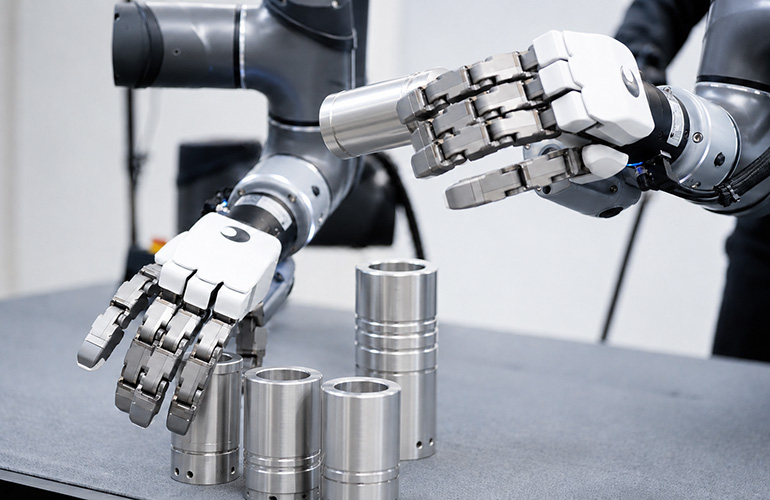
Building a humanoid robot is hard enough. Building the hands is arguably harder — and that is precisely the niche Incheon-based Tesollo has staked out. Now the company is turning its robotic dexterity into a financial play, having selected KB Securities as its underwriter for an initial public offering. The listing is targeted for after 2027, so this is a long game rather than an imminent market debut.
What makes the IPO more than boardroom noise is the hardware underneath it. Tesollo’s latest product, the DG-5F-S, is a compact, lightweight humanoid robotic hand that officially reached commercialization in February 2026 after showing off an early prototype at CES 2026.
The headline number is dexterity. The DG-5F-S packs 20 degrees of freedom, aiming to reproduce the fine, human-like articulation that separates a genuinely useful manipulator from a glorified gripper. It measures 21 cm and tips the scales at just 880 g (1.94 lb), which keeps it viable as an end-effector on robot arms where every gram of payload counts.
Crucially, the joints are backdrivable. That mechanical compliance means the hand can yield when it meets resistance rather than plowing through it — a safety and durability feature that matters enormously when a robot is expected to share space, and objects, with people.
For teams that want a leaner package, Tesollo offers an optional 15-DoF variant. It trades some articulation for a smaller footprint and simpler motion control, a sensible option when the task doesn’t demand full finger independence and you’d rather not manage the complexity of 20 axes.
Pricing is where things stay deliberately vague. Tesollo hasn’t published a confirmed figure in dollars, pounds or euros. What it has said is relative: the DG-5F-S is positioned at roughly 60% of the price of the DG-5F model. In other words, this is the more accessible sibling in the lineup — a move that reads as an attempt to broaden adoption ahead of that eventual public listing.
The strategy makes sense. Humanoid robotics is one of the hottest and most capital-hungry corners of the industry right now, and the hand remains a stubborn engineering bottleneck. A company that can supply compact, compliant, high-DoF hands to the wave of humanoid developers has a genuinely defensible position. Pairing that with an IPO gives Tesollo the runway to scale manufacturing and R&D just as demand ramps up.
Whether investors bite after 2027 will depend on how many humanoids actually make it out of the lab. But if the field grows the way its backers predict, the companies selling the parts everyone needs — the hands, the actuators, the fingers that can grasp an egg without crushing it — may prove to be the smartest bet of all.