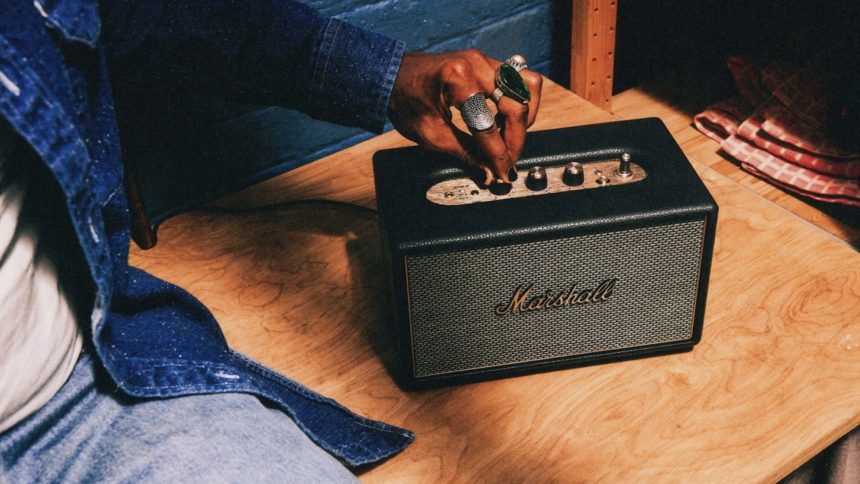
Marshall’s iconic amp aesthetic is back, this time wrapped around two refreshed Bluetooth speakers that promise a bigger, room-filling wallop. The Acton IV and Stanmore IV went on sale on July 8, 2026, bringing upgraded drivers, fresh inputs and multi-speaker tricks to the retro-styled lineup.
Start with the smaller sibling. The Acton IV packs a single 4-inch woofer flanked by two 0.75-inch tweeters, the latter now fitted with waveguides to help spread the sound across a room rather than firing it straight at your ears. Powering all of that is a trio of Class D amplifiers — one 60W unit for the woofer and two 25W amps for the tweeters. Marshall quotes a frequency range of 37–38,000 Hz and a maximum sound pressure level of 95 dB SPL @ 1 m, which is plenty for filling a living room with your questionable taste in music.
Connectivity is where the Acton IV really shows its age well. It runs Bluetooth 5.3 Auracast, a 3.5 mm AUX input, and a codec spread that covers SBC, AAC (MPEG-2), LDAC and LC3. Auracast support means you can broadcast to multiple compatible speakers at once, a genuinely useful upgrade for anyone building a multi-room setup without wires snaking everywhere. It sells for $299.99 (£259.99, €299).
Step up to the Stanmore IV and the woofer grows to 5 inches, again paired with two 0.75-inch tweeters. The amplifier layout mirrors its smaller sibling — a 60W Class D amp for the woofer and two 25W amps for the tweeters — while the frequency range dips slightly lower to 36Hz to 38KHz for a touch more bass authority.
The Stanmore IV also leans into its living-room ambitions with a wider set of inputs. Alongside Bluetooth Auracast and a 3.5 mm AUX stereo jack, it adds an RCA input, so vinyl fans and anyone hanging onto legacy source gear have a proper home for their cables. It was announced on July 7, 2026 and became available immediately, priced at $399.99 (£349.99, €399).
Both speakers stay faithful to the design language that made Marshall’s audio range instantly recognizable — the textured vinyl wrap, the brass-look script logo and the analog-style top controls that let you tweak volume, bass and treble by hand rather than fishing around in an app. It’s a formula that has aged remarkably gracefully, and the fourth generation refines the recipe rather than reinventing it.
What’s most notable here is the shift toward Auracast across the lineup. It’s a nod to where wireless audio is heading, and it makes these classic-looking boxes more future-proof than their throwback styling might suggest. If you’ve been eyeing a Marshall speaker, the IV models make a compelling case.