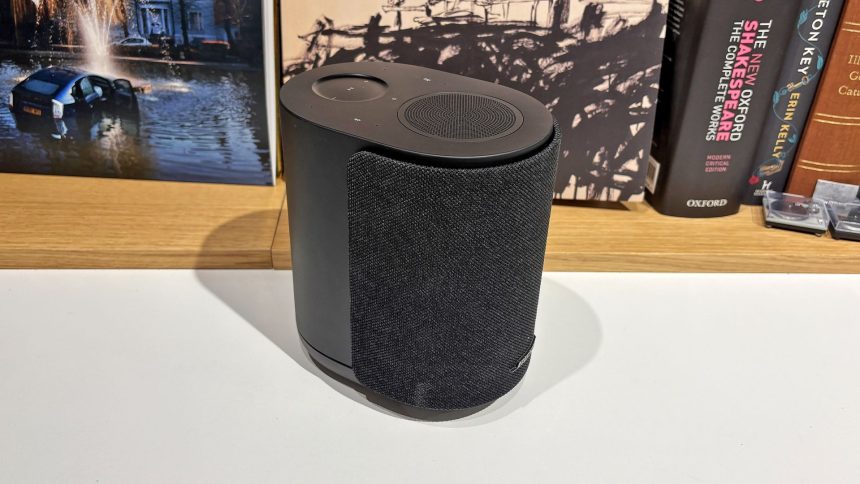
Bose has a habit of building speakers that sound bigger than they look, and the Lifestyle Ultra Speaker is clearly cut from that cloth. What’s less clear is exactly where it slots into an already brutal wireless speaker market — a question that lingers even after you’ve admired the spec sheet.
Let’s start with what’s under the grille. This is a three-driver arrangement: two front-facing drivers handle the direct sound, while a single up-firing driver bounces audio off the ceiling for a taller, more enveloping presentation. It’s a compact design at 7.27 x 4.77 x 6.59 inches and 3.7 pounds, so it’s the kind of speaker you can move from a kitchen counter to a bedside table without a second thought.
Connectivity is where Bose has covered its bases. Over Wi-Fi you get Google Cast, Apple AirPlay and Spotify Connect, which means it plays nicely regardless of which ecosystem you’ve committed to. For everything else there’s Bluetooth and a good old 3.5mm AUX input, the latter a welcome nod to anyone still spinning something wired. Voice control comes courtesy of Alexa+ built-in, letting you bark commands without reaching for your phone.
The standard model went on sale for US$299 (£299.95 in the UK) following its launch on May 15, 2026. If you fancy something a little less anonymous than the usual matte-black slab, there’s also a limited-edition Driftwood Sand finish for US$349 — a modest premium for a bit of shelf-appeal.
On paper, this is a tidy package: the up-firing driver hints at genuine spatial ambition, the multi-platform streaming support removes the usual ecosystem headaches, and the price sits comfortably in the mid-range. Bose’s tuning pedigree does the rest of the heavy lifting.
So why the head-scratching? At US$299, the Lifestyle Ultra Speaker lands squarely in one of the most fiercely contested corners of the audio world, wedged between cheaper smart speakers that do the basics and pricier multi-room systems that promise the moon. It has to justify itself against both, and it does so mostly on the strength of Bose’s name and that clever three-driver geometry rather than any single killer feature.
That’s not a knock so much as a note of caution. For listeners already invested in AirPlay or Google Cast who want a compact, well-built speaker with room-filling ambitions and a familiar acoustic signature, this is an easy recommendation. For everyone else weighing it against the mountain of alternatives, it’s less an obvious slam-dunk and more a quietly confident contender that expects you to already trust the badge on the front.