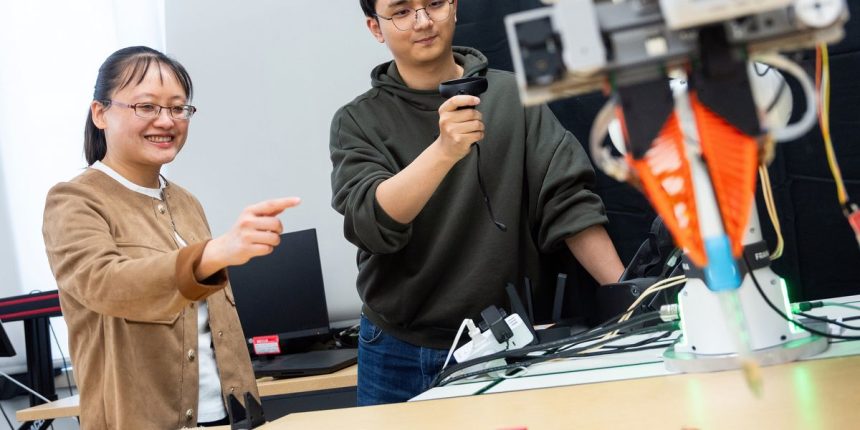
Robots are excellent at repeating a task they’ve seen before, and terrible at admitting when they haven’t. Traditionally, a robot trained to slice an apple will keep swinging the knife even after the fruit rolls to a new angle — accumulating small errors until the whole system crashes. Yen-Ling Kuo, an assistant professor of computer science at the University of Virginia, has built a smarter way for machines to raise their hand and say, I’m not sure about this one.
Her paper, “Diff-DAgger: Uncertainty Estimation with Diffusion Policy for Robotic Manipulation,” earned the IEEE Robotics and Automation Society’s inaugural Outstanding Women in Robotics and Automation Early Career Contribution Award. The core idea is elegant. Instead of training multiple copies of a model and watching for disagreement — the popular but clunky approach — Diff-DAgger repurposes the diffusion loss, the signal a robot normally uses to refine its model during training, as a live confidence check.
During execution, the robot continuously computes that signal and runs a statistical test against values from its training data. When it encounters something unfamiliar, the signal spikes; when its current action closely matches what it already learned, the signal stays quiet. That spike is essentially the robot self-diagnosing an imminent failure and calling for a human only when it genuinely needs one.
The payoff isn’t just cleaner benchmarks. Cutting human supervision and slashing wasted correction data opens a path for far more complex, data-hungry models to be dropped into interactive robot learning without drowning researchers in babysitting duties.
Kuo’s route here reads like a full circle. Growing up in Taiwan, she caught the programming bug through Logo’s turtle cursor, earned bachelor’s and master’s degrees at National Taiwan University, then spent nearly four years at Google — leading the Shop the Look initiative, a predecessor to Google’s current AI-powered shopping search. Applying neural networks she didn’t fully understand nagged at her, so in 2016 she returned to MIT for a Ph.D., which she completed in 2022 with a minor in cognitive science.
That cognitive angle now drives her broader mission at UVA: giving robots a working theory of mind. She wants machines that read not just explicit data but silent cues — language, movement, even a person’s gaze — the way roommates coordinate a move without saying much. As service robots and self-driving vehicles spread, teaching machines when to ask for help may prove just as valuable as teaching them what to do.