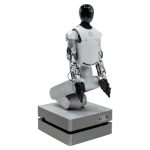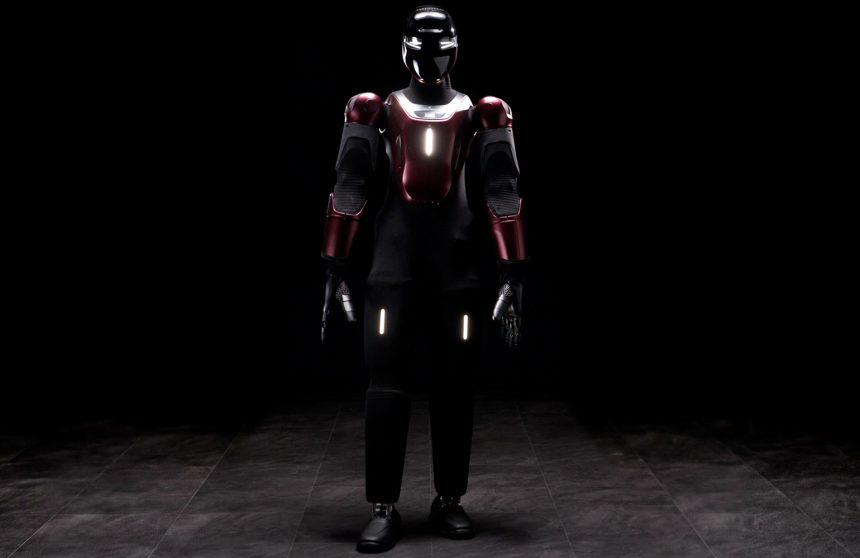
Most humanoid robots see the world through cameras and lidar. Italian deep tech firm Generative Bionics wants its machine to feel it instead. The company’s Gene.01 arrives wrapped in a full-body distributed tactile skin — a sensing layer that lets the robot register touch, temperature, proximity and force across its entire frame.
That combination matters. A robot that can sense proximity across its whole body doesn’t just react when something bumps into it; it anticipates a human’s presence and adjusts before contact happens. For machines expected to share space with people, that shift from reactive to predictive is the difference between a novelty and a colleague.
Under the skin, Gene.01 runs what Generative Bionics calls physics-native AI — a Physical AI approach with roots in the Italian Institute of Technology’s well-regarded humanoid research, drawing on the iCub, ergoCub and iRonCub platforms. The compute lives on AMD processors, and the company says the whole robot was built in just six months, an unusually brisk timeline for a full humanoid.
On the hardware side, the spec sheet reads like a checklist of the hard problems in robotics:
- Bipedal locomotion across uneven terrain, rather than the flat-floor demos that flatter most humanoids
- Dexterous manipulation through multi-fingered hands
- Advanced balancing for dynamic stability when the robot is pushed, loaded or moving fast
Tie those capabilities to a body that can feel force and contact everywhere, and you get a machine designed to work in the messy, unpredictable environments where people actually operate — not a stage.
Gene.01 was unveiled on July 20, 2026. Its U.S. debut comes at the AMD Advancing AI 2026 event, running July 22–23, which is a fitting stage given the AMD silicon at its core. Showing up alongside the chipmaker’s flagship AI showcase signals where Generative Bionics sees the humanoid conversation heading: less about the mechanical spectacle, more about the intelligence and sensing that make a robot trustworthy around humans.
For now, Gene.01 remains a prototype. There’s no consumer or commercial price, and you can’t buy one — the company plans a commercial version in Q4 2026. Whether the six-month build pace carries over into a shippable product is the open question, but the pitch is clear enough. Vision-first humanoids have dominated the headlines; Generative Bionics is betting that a sense of touch, spread across every surface, is what finally lets these machines move through the world the way we do.
If it works, the next generation of humanoids won’t just watch you walk past. They’ll feel you coming.