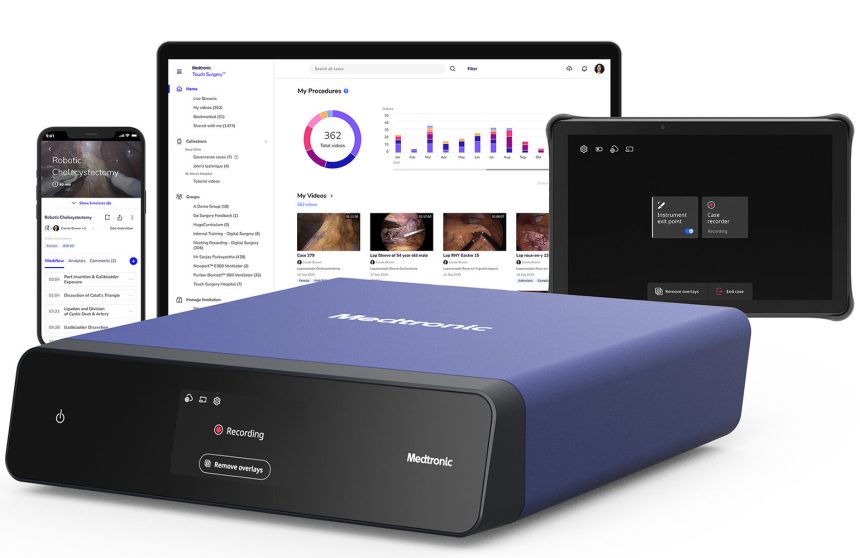
The operating room is about to get a computing brain. Medtronic has pulled back the curtain on Touch Surgery™ Aide, an AI-native surgical computing platform designed to sit at the heart of its Touch Surgery ecosystem. An early look at the technology is being shared this week at the Society of Robotic Surgery (SRS) 2026 Annual Meeting in Florida, running July 23-26, after the platform was announced on July 21, 2026.
What makes this more than another dashboard bolted onto a surgical rig is the raw processing ambition. Touch Surgery Aide fuses computer vision, multimodal AI and accelerated inference to read surgical video and procedural context in real time. In practice, that means the system doesn’t just record what’s happening on the table — it interprets it as the operation unfolds, turning a live feed into structured, actionable understanding.
Under the hood, Medtronic is leaning on NVIDIA’s accelerated computing stack. The platform incorporates Holoscan, CUDA and TensorRT, the trio NVIDIA typically pitches for low-latency medical and edge AI workloads. That combination is what lets the platform chew through high-resolution surgical video fast enough to be useful mid-procedure, rather than as an after-the-fact review tool.
The broader Touch Surgery ecosystem is built to span the entire arc of a case, and Aide is positioned as the compute layer that ties it together. Medtronic frames the ecosystem as bridging three distinct phases:
- Pre-operative — planning and training before the first incision.
- Intra-operative — tele-mentoring and tele-proctoring, so a senior surgeon can guide a procedure remotely and in real time.
- Post-operative — insights and analytics drawn from what actually happened during the case.
That intra-operative piece is arguably the most intriguing. Real-time tele-proctoring depends on latency low enough that a remote expert’s guidance stays relevant to the moment, which is exactly the kind of problem NVIDIA’s inference tooling is meant to solve. If it works as described, geography stops being a hard limit on who can look over a surgeon’s shoulder.
A few important caveats. Medtronic itself is calling this an early look and an early step, which is telling language. Touch Surgery Aide is not yet available to buy, and the company has not disclosed pricing or a firm commercial timeline. What’s on show in Florida is a statement of direction as much as a product.
Still, the direction is clear enough. By treating the OR as a place that generates continuous, machine-readable data — and by putting a purpose-built AI computer in the room to make sense of it — Medtronic is betting that surgery’s next leap comes not from new instruments, but from software that understands what those instruments are doing.