Every so often a toy roundup throws up one item that quietly rewrites the rules, and this year it’s Lego’s Smart Play System. The magic sits inside a 2- by 4-stud rechargeable smart brick that crams in a synthesizer, speaker, accelerometer, gyroscope, light and sound sensors, and LEDs. A built-in positioning system can even sense orientation between multiple smart bricks, so your creations know where they stand in relation to one another. Best of all, the whole thing runs entirely without a screen — a rare and welcome thing in kids’ tech.
Pair those bricks with programmable NFC tags and minifigures and you get creations that react to lights, sounds, motion and sensing. Lego’s first Pokemon collaboration reportedly almost took down the company’s website, so it was a safe bet the Danes had IT on standby when 12 new Smart Play kits arrived.
What’s on offer
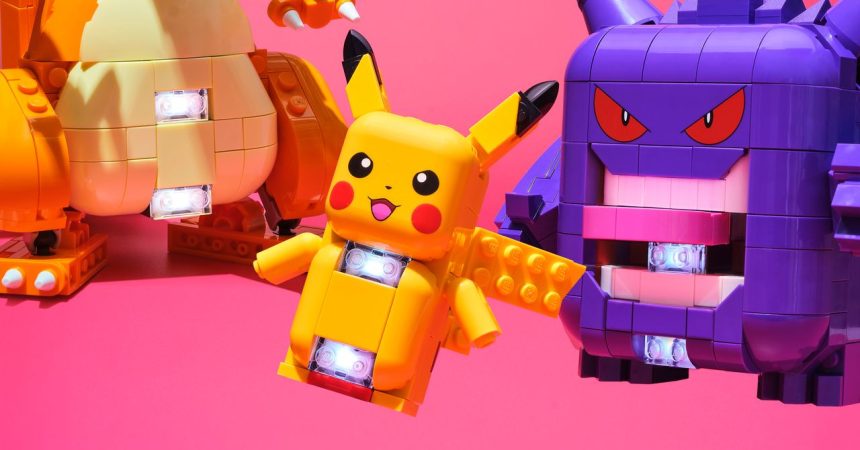
- Two all-in-one kits ship with the rechargeable smart bricks and NFC tags: Pikachu’s 400-piece Training House and the 751-piece Charizard-Jolteon battle.
- Ten further compatible kits — including Mewtwo’s Lab Break and Cubone and Gengar’s Spooky Showdown — include the tags but not the smart bricks, ideal if you’ve already invested in the system.
Prices start at $70, and the range lives at lego.com.
The clever bit is how the smart brick turns passive building into something responsive. Tilt, tap or move your build and the accelerometer, gyroscope and sensors feed that into the synth and LEDs, so a Charizard battle can throw out sounds and lights on cue rather than sitting inertly on the shelf. The positioning system that reads orientation between bricks hints at multi-brick scenes where separate creations become aware of each other — the kind of open-ended play that keeps a set alive long after the instruction booklet has been lost under the sofa.
Why it stands out
Plenty of connected toys lean on a tablet to do the heavy lifting, quietly funnelling kids back toward a glowing rectangle. Lego has gone the other way: the intelligence is baked into the plastic itself. For anyone weary of “smart” toys that are really just app launchers, that screen-free approach is the headline feature, not a footnote.
The two flagship kits are the natural starting point thanks to those included smart bricks, while the tag-only expansions reward collectors who want to grow their roster of interactive Pokemon without paying for hardware twice. Given how the first Pokemon collab performed, expecting these to hang around in stock indefinitely feels optimistic — but as a blueprint for physical, tactile, brain-engaging play, the Smart Play System is one of the more genuinely forward-looking toys around.