Teaching a robot to fold laundry or pour a coffee sounds trivial until you realize how much real-world data it takes to get there. That data has historically been slow and eye-wateringly expensive to gather. Singapore-based Ropedia reckons it has cracked the problem, and investors agree: the company just closed a $22 million Pre-Series A round.
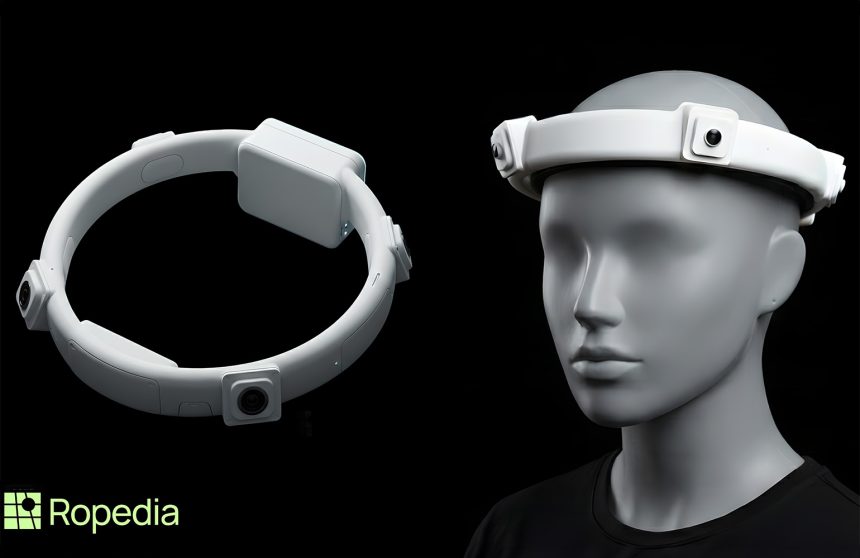
At the heart of Ropedia’s pitch is HOMIE, a head-mounted wearable fitted with a 360° camera view. Strap it on, go about ordinary human tasks, and it captures rich first-person footage of exactly what your hands, eyes and surroundings are doing. That egocentric perspective is gold for physical AI, because it mirrors the vantage point a robot ultimately needs to reason from — no elaborate motion-capture rig or robot arm required.
The result is a flood of training material. Ropedia’s flagship dataset, Xperience-10M, already contains more than 10,000 hours of multimodal recordings and 10 million interaction episodes. That is the kind of scale that makes a robot’s grasp of the messy real world less brittle and more generalizable.
The headline number, though, is cost. Ropedia claims its data collection runs 50 times lower than traditional methods. In a field where the bottleneck isn’t clever algorithms so much as the sheer volume of quality demonstration data, driving that price down by nearly two orders of magnitude could reshape who can afford to build capable robots at all.
A quick reality check on what Ropedia actually is: this isn’t a gadget you’ll be adding to a cart. The company operates as a data infrastructure business for robotics, selling a B2B platform, data-as-a-service and selective hardware access to the companies building the machines. HOMIE is a tool for that ecosystem rather than a consumer product.
The funding math tells its own story of momentum. The new $22 million stacks on top of $8 million raised in March 2026, bringing Ropedia’s total pre-A haul to $30 million. Not bad for a company only founded in 2025, now split across offices in Singapore and Mountain View, California — a footprint that neatly straddles Asia’s hardware supply chains and Silicon Valley’s AI money.
What Ropedia is betting on is a broader shift in robotics thinking. The field has spent years chasing better models and slicker hardware, but the smartest robot in the world is only as good as the experience it learns from. By making that experience cheap and abundant, Ropedia is angling to become the quiet supplier underpinning everyone else’s flashy demos.
Whether the 50x cost claim holds up across diverse real-world tasks is the question worth watching. If it does, the humble head-mounted camera could turn out to be one of the more consequential pieces of kit in the robotics stack.