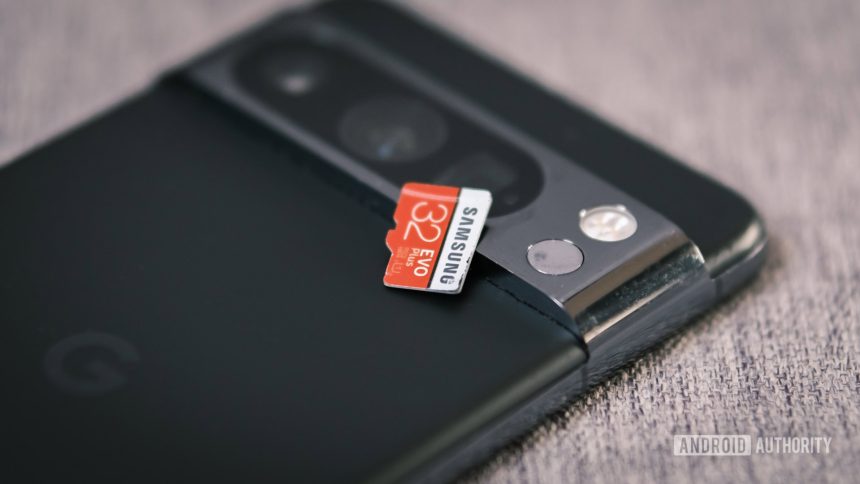
Remember when adding storage to your phone meant popping open a plastic tray and sliding in a fingernail-sized card? For a lot of Android holdouts, that moment never really went away — and in 2026, the case for bringing microSD back is stronger than it’s been in years.
The logic is simple economics. Manufacturers have long treated built-in storage as a premium upsell, charging eye-watering markups to jump from one capacity tier to the next. When the physical NAND that separates a 256GB phone from a 512GB one costs a fraction of what you’re asked to pay at checkout, that upgrade path starts to feel less like a feature and more like a tax.
Enter the humble removable card, which has quietly kept evolving while flagship phones abandoned the slot. The format is no longer the slow, cramped afterthought it used to be. Consider what’s arriving on shelves:
- SanDisk 4TB microSDUC — the storage giant confirmed its 4TB microSD card at Computex 2026, alongside an 8TB SDUC in the full-size format. Four terabytes on a chip you could lose in your pocket lint is a genuinely absurd milestone.
- Samsung T7 and T9 portable SSDs — Samsung rolled out its new T7 and T9 portable SSD lineup in the Philippines in June 2026, signalling that the major players still see life in expandable storage.
That’s the crux of the argument. If a single card can now hold four terabytes, the difference between phone storage tiers becomes almost irrelevant. Buy the cheapest capacity your device offers, drop in a card, and skip the premium entirely. For anyone who shoots high-resolution video, hoards offline media libraries, or simply resents paying flagship margins for flash memory, that flexibility is worth reopening the conversation.
There are trade-offs, of course, and they’re the reason the slot vanished in the first place. Removable cards are typically slower than the internal UFS storage soldered into modern phones, they can be a weak point for reliability, and ditching the tray freed up internal space for bigger batteries and better water resistance. Purists will argue those gains were worth losing the expandability.
But the market has shifted underneath those old assumptions. Storage upgrade pricing has become harder to justify, capacities have exploded, and a fair number of Android phones never abandoned the microSD slot to begin with. The technology that once felt like a legacy holdover suddenly looks like the smarter, cheaper way to future-proof a device.
The comeback isn’t guaranteed — flagship makers have every financial incentive to keep storage locked and lucrative. Yet with 4TB and 8TB cards heading to market, the balance of value is tilting back toward the slot. If you’ve been quietly missing that little plastic tray, you’re not alone, and you might finally have the numbers to back you up.