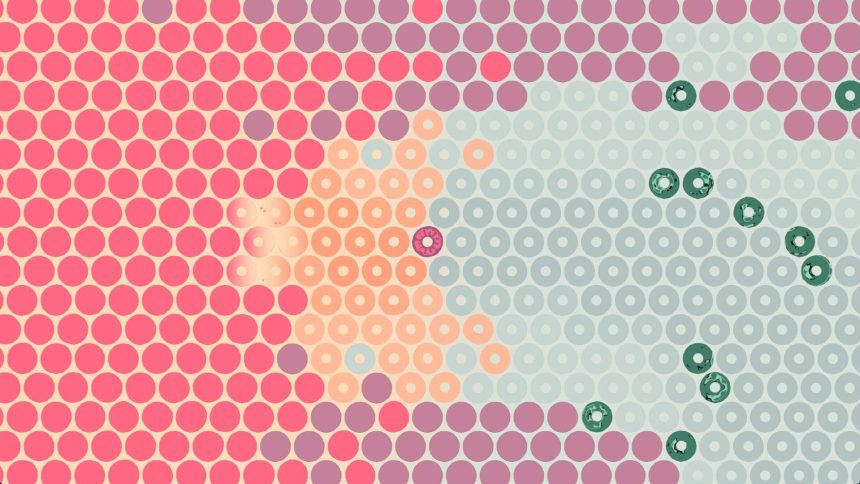
Every so often a game arrives with a premise so committed to its own logic that you can’t look away. What Surrounds Us is one of them. You play as a circle — a ring with a hole in the middle, looking uncannily like a frosted donut — and everything around you is built from circles too. It’s not just a stylistic tic. The endless loops and rings underpin the game’s central idea: that we exist in connection with our environment and the things around us.
The setup is disarmingly simple. Your circular protagonist shares its world with other sentient, moving circles, and part of the joy comes from working alongside them — sometimes literally helping them find and meet one another. It’s cooperative in spirit even when you’re playing solo, a game about linkage rather than conquest.
For all the trippy, abstract presentation, though, the structure underneath is reassuringly classic. Trekking across the map, The Verge‘s writer kept catching echoes of The Legend of Zelda — the sense of a large, connected world laid out for exploration, with three distinct regions to traverse. That’s a smart pairing: an avant-garde visual language wrapped around an adventure framework players already understand instinctively.
The map itself is one continuous composition of circles, so navigation becomes a kind of visual puzzle. You’re constantly reading the geometry around you, figuring out how your ring-shaped body fits into a landscape made of the same shape. It’s the sort of design where form and theme reinforce each other rather than fighting for attention.
What makes the concept land is restraint. Plenty of games chase abstraction and end up feeling like a screensaver you can’t turn off. What Surrounds Us instead uses its single, repeated motif to say something — about interdependence, about how the space around you shapes what you can do. The circles everywhere aren’t decoration; they’re the argument.
If you’ve ever wanted a Zelda-style journey filtered through a minimalist art installation, this is a curiously specific itch being scratched. It’s the kind of small, idea-driven project that reminds you the medium still has room for games built around a single, elegant thought — and then follows that thought all the way through.
You can read the full impressions at The Verge.