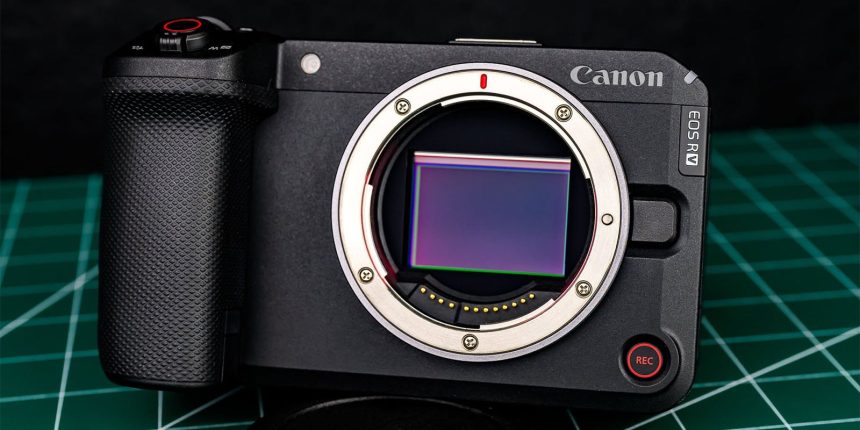
Canon has quietly patched one of the more glaring gaps in its video-first mirrorless lineup. Firmware 1.1.0 for the EOS R6 V — released on July 24, 2026 — adds the ability to shoot with flash, a feature the camera oddly shipped without when it went on sale June 24.
Why the omission in the first place? The R6 V leans hard toward moving pictures. It skips the mechanical shutter found on its sibling, the R6 Mark III, relying entirely on electronic readout. And since the R6 III can’t use flash in its electronic-shutter mode either, the shutterless R6 V arrived flash-less by design. Firmware now works around that limitation, though with strings attached.
The catch is sync speed. According to DPReview, flash on the R6 V is capped at a maximum sync of just 1/60s — glacially slow by any standard, and a real constraint for anyone hoping to balance strobes against bright ambient light. There’s also the hardware side: the R6 V lacks a traditional five-pin hotshoe, so it plays nice with Canon’s Multi-Interface Speedlite units but not with older, conventional flashes.
Still, for hybrid shooters who occasionally need a burst of light, having the option at all is a meaningful step up from nothing. It was a conspicuous hole in the spec sheet of a $2,499 camera built around a 32.5MP front-side-illuminated sensor, 7K 60p RAW capture, 7K 30p Open Gate, uncropped 4K 120p recording and an internal cooling fan for marathon takes.
Flash isn’t the only change in 1.1.0. Canon also baked in:
- Support for the new BR-E2 Wireless Remote Controller
- Canon SDK compatibility for tethered and developer workflows
- Assorted bug fixes and the ever-present “improved operational stability”
The EOS R6 Mark III gets its own bump to version 1.1.0 in parallel. It picks up BR-E2 remote support and SDK compatibility too, plus a couple of features that were already living on the R6 V: an autofocus mode tuned for close-up product demos, and a grid display during movie recording. Canon squashed some potentially maddening bugs along the way, including FTP transfer errors, an interval-shooting glitch and a USB problem — and, naturally, promises smoother operation all round.
Both updates are available to download now. Neither firmware transforms these cameras into something they weren’t, but the R6 V’s newfound flash trick — however hobbled by that 1/60s ceiling — closes a gap that hybrid shooters had every right to grumble about.