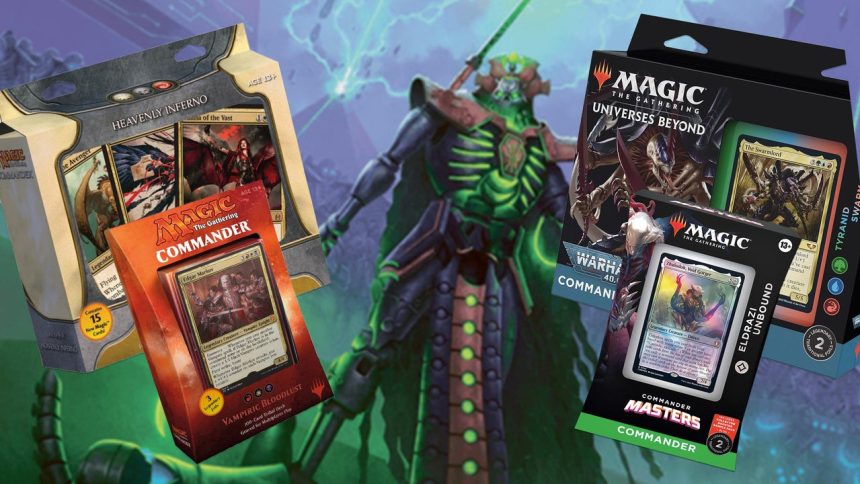
Commander remains the beating heart of Magic: The Gathering, and for most players the fastest way into the format is a preconstructed deck. These boxed “precons” arrive shuffle-ready out of the wrapper, no card-shop treasure hunt required — but not all of them are created equal. Some are gentle on-ramps for newcomers, while a rare few punch so far above their weight that seasoned players keep them intact for years.
That gap in raw power is exactly why the debate over the strongest precons of all time never really cools down. Since Wizards of the Coast began mass-producing these decks, dozens have shipped across yearly sets and, more recently, Universes Beyond crossovers that fold in properties from outside Magic’s own multiverse. The best of them stand out for a handful of reasons.
What separates a merely solid precon from a genuinely powerful one usually comes down to:
- Commander synergy — a legendary creature whose ability shapes the whole deck around a coherent, repeatable plan.
- Mana consistency — a manabase that actually casts the spells it’s built to cast, rather than leaving you stranded.
- Reprint value — staple cards that would cost a small fortune to assemble singly, bundled at a fraction of the price.
- Out-of-box viability — the deck wins games without demanding an immediate stack of upgrades.
The inclusion of Universes Beyond products in these rankings is worth pausing on. By licensing outside franchises, Wizards has broadened the appeal of Commander far past its traditional audience, and several of those crossover decks have proven to be more than novelty pieces — they hold their own on the table against decks drawn purely from Magic’s home sets.
For anyone building a first Commander pool, a strong precon is arguably the single best value in the game. You get a functioning strategy, a headline commander, and a clutch of reprints that soften the notorious cost of assembling a deck card by card. For veterans, the appeal is different: the top-tier releases serve as upgrade bases, their bones sturdy enough to support hundreds of pounds of eventual tweaks.
Ranking them is inevitably a matter of taste as much as metrics. Power on a competitive table is one yardstick; sheer fun at a casual pod is another entirely, and the two don’t always agree. A deck that dominates in a cutthroat game can feel oppressive among friends, while a lower-tier precon might deliver exactly the kind of chaotic, memorable game most kitchen-table groups are after.
Whichever way you weigh those factors, the enduring lesson is that the humble precon has quietly become one of Magic’s most important products — the gateway that keeps Commander growing year after year.