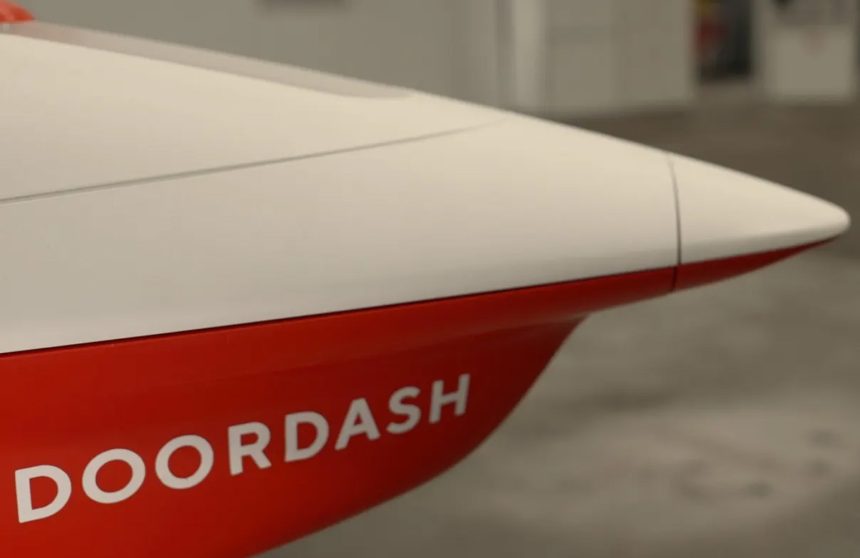
DoorDash just moved from renting other people’s drones to flying its own. On July 29, 2026, the company secured FAA Part 135 certification, the regulatory green light needed to operate a commercial drone delivery service under its own name. The program has a name to match its ambitions: DoorDash Air.
This is a notable shift in strategy. Until now, DoorDash has leaned on partners — Wing, Flytrex and Manna — to lift burritos and burgers into the sky above select restaurants in parts of Dallas–Fort Worth, TX, and Charlotte, NC. Those partnerships remain, but the Part 135 nod signals that DoorDash increasingly wants to own the whole stack, from the app you tap to the rotor that hums over your driveway.
The aircraft is being developed by DoorDash Labs, the company’s in-house robotics and autonomy group. The team is aiming squarely at mid-range deliveries, and there’s a distinctly patriotic pitch attached: the drones will be, in the company’s words, “proudly American-designed and built, with the majority of components made right here in the U.S.”
So how quick is drone delivery when it works? DoorDash cites early numbers from its partner-run flights: deliveries covering less than five miles have averaged under 25 minutes. That’s the kind of window that makes the difference between hot fries and a soggy disappointment — and it’s the benchmark DoorDash Air will need to hit or beat with its own hardware.
A quick reality check on timing: certification doesn’t mean packages are dropping today. The FAA confirmed that DoorDash has not yet begun its own deliveries. The company expects to start in-house commercial drone deliveries in the US in fall 2026, so the first DoorDash-branded aircraft won’t be buzzing overhead until later this year.
The broader picture is worth pausing on. Part 135 is the same certification framework that legitimizes small charter and on-demand air operators, and earning it for autonomous delivery is genuinely hard — it took DoorDash nearly a year of work following the reveal of its delivery robot. That effort tells you how serious the company is about automation. Rather than treating drones as a novelty bolted onto a food app, DoorDash is building an operator, an aircraft and a supply chain, all under one roof.
There are still open questions. We don’t yet know the drone’s payload, range specifics beyond the “mid-range” target, or which cities get DoorDash Air first. But the direction is unmistakable: the company that helped normalize the tap-to-eat lifestyle now wants to control the airspace above it, one sub-25-minute flight at a time.
If it works at scale, the humble food delivery could quietly become one of the most visible everyday uses of commercial drones in America.