What does it mean to point a camera at the worst and the best of human experience? That’s the question at the heart of Inferno & Paradiso, an immersive slide-projection exhibition now running at the Photo Elysée in Lausanne, Switzerland, until November 1, 2026.
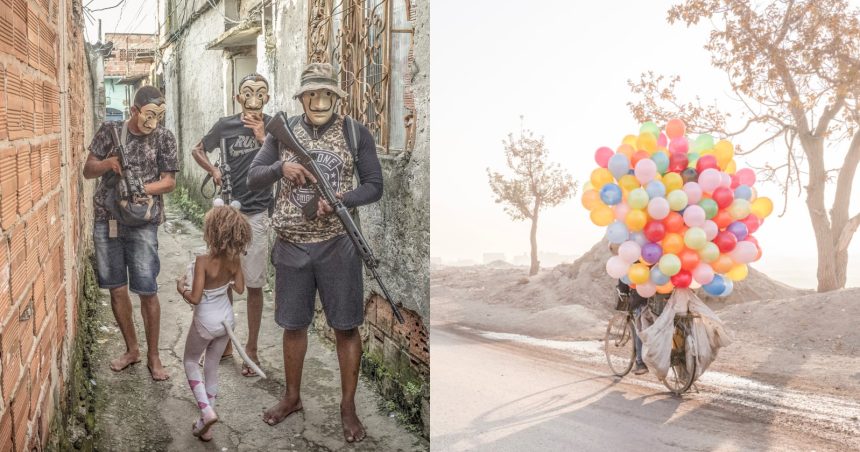
Conceived by Alfredo Jaar — one of the most socially engaged artists of his generation — the show gathers 40 photographs from 20 reportage photojournalists. Jaar handpicked each contributor for their ability to capture the complexity of modern human experience, then gave every one of them the same deceptively simple assignment: choose two images from your archive. One should be the most distressing photograph you’ve ever taken. The other, the one that gave you the greatest sense of joy and hope.
The results span the planet’s fault lines. The selected images document crises and conflicts in Ukraine, Argentina, Gaza, New York, the Congo, and the Philippines, with contributors including Anastasia Taylor-Lind, Véronique De Viguerie, Hannah Reyes Morales, Johanna-Maria Fritz, Bülent Kılıç, and Lindokuhle Sobekwa. Scenes of suffering sit alongside moments of resilience and happiness, mapping the enormous distance between the darkest and brightest corners of human life.
The staging is what makes it more than a wall of prints. Visitors step into a darkened room where the photographs are projected in 20-minute cycles. Images tied to hope and joy play together first, followed by a sequence devoted to suffering and hardship. Each theme holds you for a full 20 minutes — long enough that you can’t simply glance and move on. It’s a deliberate antidote to the endless, frictionless scroll that most of these pictures would otherwise live in.
That’s the exhibition’s sharper argument. Inferno & Paradiso pushes back on the familiar claim that audiences have gone numb to a constant stream of images showing suffering. Jaar’s counter-thesis is that the real problem lies in how people are presented. Too often, viewers see anonymous figures rather than individuals — human beings capable of sharing their own experiences and telling their own stories. Strip away that anonymity, the show suggests, and the numbness starts to lift.
There’s a second challenge folded in, aimed squarely at the visitor. The exhibition asks each person to examine how they respond to images of both suffering and hope, and what meaning they carry away. It’s less a gallery to be admired than a mirror held up to the way we consume the world’s most difficult pictures.
For anyone who cares about photojournalism — its ethics, its power, and its limits — Inferno & Paradiso is a rare chance to sit with the medium rather than swipe past it. The show runs at the Photo Elysée in Lausanne until November 1, 2026.