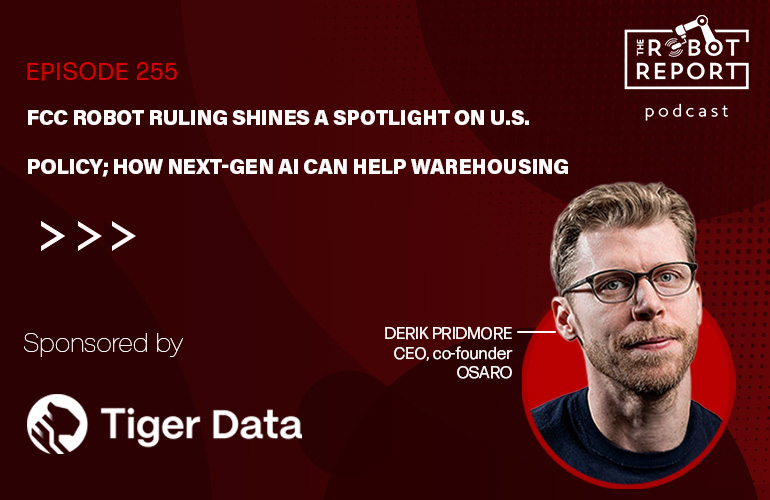
Warehouse robotics has spent the last few years chasing one goal: reliability at scale. But a regulatory jolt just reminded the industry that policy can move as fast as any algorithm. On July 28, 2026, the FCC added certain foreign-produced advanced robotic devices to its Covered List — a regulatory action that reaches across multiple manufacturers rather than singling out one product launch.
For the companies deploying these machines, the ruling is more than paperwork. The Covered List determines which gear can legally connect and operate in the U.S., and adding advanced robots to it puts sourcing, supply chains and procurement plans under a new kind of scrutiny. Suddenly, the origin of a robotic arm matters as much as its payload rating.
Against that backdrop, OSARO’s Derek Pridmore makes a case that cuts through the hype. Yes, warehouse robots are advancing quickly — but the leap from an impressive demo to a machine you trust on a live fulfillment line is enormous. Real-world safety and reliability, Pridmore argues, don’t come from a single monolithic model doing everything at once.
Instead, they come from specialized, layered AI systems. Think of it as division of labor inside the software stack:
- Perception that reliably identifies and locates items in messy, unpredictable bins
- Grasp planning tuned to the specific shapes, materials and orientations a robot actually encounters
- Control and safety layers that keep the hardware operating within predictable, verifiable bounds
The appeal of general-purpose, next-gen AI is obvious — one brain to rule the warehouse. Pridmore’s counterpoint is that layering keeps each component testable and accountable. When something goes wrong at a pick station handling thousands of SKUs an hour, you need to know which part of the system failed and why. A single opaque model that occasionally hallucinates a grasp is a liability; a stack of narrowly scoped, well-understood modules is an engineering discipline.
That philosophy also happens to age well in a shifting regulatory climate. As the FCC ruling shows, the ground rules for deploying robots in the U.S. can change fast, and operators who understand exactly how their systems behave are better positioned to adapt. A transparent, modular AI stack is easier to audit, easier to certify, and easier to defend when a compliance question lands on the table.
The broader takeaway for anyone watching the warehouse automation race: the winners won’t necessarily be whoever ships the flashiest humanoid or the biggest model. They’ll be the teams that pair capable hardware with AI that’s engineered for accountability — and that reads U.S. policy as carefully as it reads a bin of unsorted parcels.