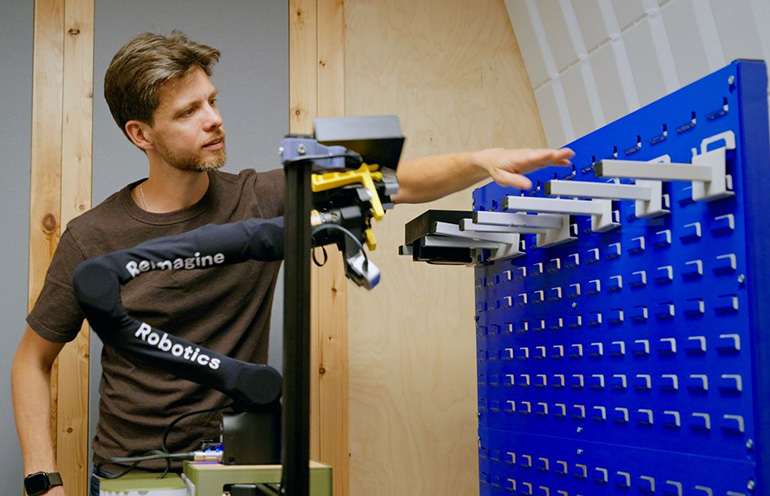
Teaching a factory robot has traditionally meant hiring someone fluent in robot dialect — a specialist who painstakingly scripts every joint angle and gripper motion. Reimagine Robotics, which stepped out of stealth today, wants to make that skill set optional.
Founded by former leaders of Google DeepMind’s Applied Robotics group, the London-based startup is building vision-enabled collaborative robots that learn on the job rather than depending on hand-written programs. The pitch is simple: instead of coding, you demonstrate, and the machine figures out the rest.
Under the hood sits a software interface driven by two familiar machine-learning approaches. Imitation learning lets the robot pick up a task by watching how it’s done, while reinforcement learning refines that behaviour through trial and error until the movement is reliable enough for a production line. Combine the two and you get a system that can adapt to new parts and workflows without a fresh round of engineering.
The company is aiming its platform at the jobs that keep modern manufacturing running but are awkward to automate with rigid scripts:
- Assembly — putting components together
- Disassembly — taking products apart, a growing need in electronics recycling
- Machine tending — loading and unloading equipment
- Material handling — moving parts between stations
What makes disassembly interesting is how messy it is. Products arrive worn, damaged or slightly different from one another, which is exactly the kind of variability that trips up conventional automation. A robot that learns from demonstration and adapts on the fly is far better suited to pulling apart used electronics than one following a fixed sequence.
This isn’t a lab curiosity, either. Reimagine says its robots are already deployed in advanced manufacturing and electronics disassembly facilities, working alongside people rather than behind safety cages — the defining trait of a collaborative robot. That real-world footing separates it from the pile of AI-robotics demos that look impressive in a controlled clip but never reach a shop floor.
The collaborative, vision-first design also lowers the barrier to entry. Because the system reads its surroundings and learns from human guidance, smaller manufacturers who could never justify a dedicated robotics team could, in principle, get an arm doing useful work far more quickly.
For now this is very much a business-to-business proposition. The platform is not commercially available to the general public, and it’s currently rolling out with a handful of select customers rather than shipping to anyone with a purchase order. There’s no consumer pricing to speak of, and the company hasn’t attached specific model names to the hardware yet.
Still, the direction is telling. If robots can genuinely absorb new tasks by watching and practising, the bottleneck in industrial automation shifts from expensive programming to simple instruction — and that could reshape who gets to automate, and how fast.