Building a humanoid startup in 2026 is a very different game than it was three years ago. The novelty has worn off, the funding has tightened, and everyone is suddenly obsessed with the same awkward question: what is this thing actually for? Walden Robotics has an answer, and it starts by throwing out one of the most sacred elements of humanoid design — the legs.
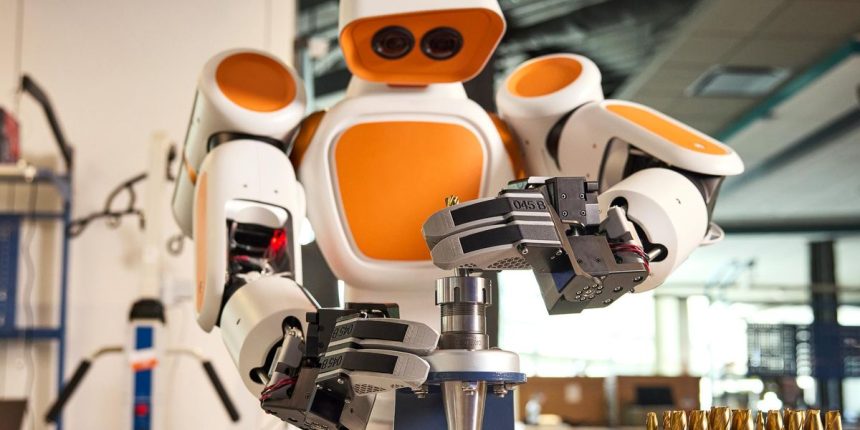
Walden emerged from stealth on July 15 with US$300 million in funding at a US$1.1 billion valuation. The company is a spinout of Toyota Research Institute (TRI), Toyota’s Silicon Valley R&D arm, and it split off in January 2026 carrying roughly a decade of hard robotics research with it. Its robot is a humanoid torso with two arms mounted on a wheeled base — deliberately, not as a compromise.
“It’s ironic,” says co-founder and CEO Russ Tedrake, who has spent 20 years thinking about legs and teaches a class on them at MIT. “There are many reasons to build a robot with legs. But the question is, what’s the addressable market? And what percentage of it is covered by a wheeled base?” That question drives the whole design philosophy: instead of building a robot and then hunting for a use case, Walden picked jobs where robots add value today and engineered a machine to fit.
The wheeled base earns its keep. It’s chunky by design, packed with batteries down low to keep the robot stable and to solve the perennial problem of running flat in the middle of a shift. More importantly, a statically stable robot can’t topple onto a coworker the way a legged one can — and factories already have safety frameworks built around autonomous mobile robots. “You can piggyback on that with a wheeled base,” Tedrake notes.
The same pragmatism applies to the hands. While rivals chase five-fingered dexterity, Walden fits simple, rugged grippers built to survive real deployment. “We have been deployed in a Toyota factory, and at the end of the week, the hands take a beating, so we built hands that can take that,” Tedrake says. “I have not seen a more dexterous hand that could have done the work our hand has done.”
That deployment is not hypothetical. Since February, Walden’s robots have been doing production work at a Toyota plant in North America, with one humanoid reportedly pulling eight-hour shifts alongside human workers. The company says the platform can quickly learn tasks like machine tending, tool setting, parts kitting, and assembly — the kind of repetitive jobs that don’t suit conveyor belts or pre-programmed arms.
The economic logic is blunt: find high-utilization roles where a robot runs 24/7. But Tedrake insists money isn’t the only driver, crediting Toyota’s people-first culture. The long game is a genuinely multi-purpose machine, built on TRI’s diffusion policy research, that learns new skills by standing on old ones. “I believe there is a single platform that can do a lot of tasks that are of high value for real customers,” he says.