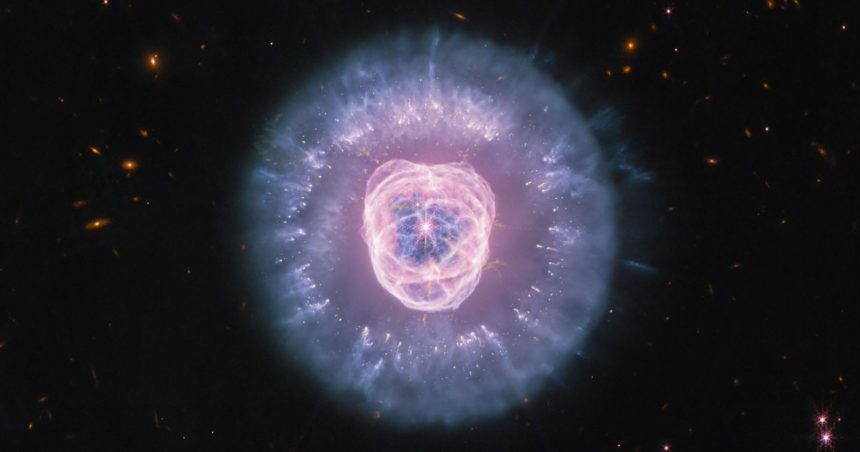
Hubble showed us the Lion Nebula a quarter of a century ago. Now the James Webb Space Telescope has returned to NGC 2392 and delivered a view so sharp it makes the old orange-tinted portrait from 2000 look like a warm-up act.
The new imagery, released on August 10, 2026, combines data from Webb’s two flagship instruments — the Near-Infrared Camera (NIRCam) and the Mid-Infrared Instrument (MIRI). Where Hubble worked mostly in visible light, Webb’s infrared vision cuts through the haze to reveal features nobody had seen before: compact clumps of dust, a shimmering veil of ionized gas, and the intricate architecture of a planetary nebula that has taken several thousand years to sculpt itself into its current shape.
What you’re actually looking at is a stellar death scene. At the heart of the nebula sits a white dwarf — the exhausted core of what was once a relatively low-mass star. Unlike massive stars, which exit in a supernova blast, this one ran out of nuclear fuel, grew unstable, and began pulsating. Those pulses flung off its outer layers, and those shed layers became the glowing shells of gas and dust we now admire.
The white dwarf isn’t finished, though. It’s cooking the surrounding material from the inside out, inflating an enormous bubble of ionized gas. Driven outward by the dying star’s radiation, that bubble bulldozes the dust in its path. Exactly why the destroyed material reorganizes itself into complex rings and shells is still an open question that scientists are working through.
Astronomers have leaned into the nebula’s nickname with the imagery:
- The gas bubble forms the lion’s face
- The central white dwarf plays the role of a button nose
- The illuminated interior of a dust shell becomes the mane
- Cometary tails of material read as tufts of fur
It’s a fitting bit of anthropomorphism, even if Webb’s palette is cooler and less tawny than Hubble’s crowd-pleasing orange. What Webb loses in lion-like coloring it more than repays in raw detail.
There’s a melancholy footnote to all this beauty. Like Hubble’s snapshot 26 years ago, Webb’s photos freeze a single instant of an object that is evolving fast on cosmic timescales. Scientists estimate that in roughly 10,000 years the Lion Nebula will have dispersed entirely, its rings and shells fading into the abyss. Catch it while you can — this particular lion won’t be roaring forever.
Image credits: NASA, ESA, CSA, STScI. Image processing by A. Pagan (STScI).