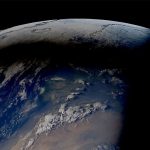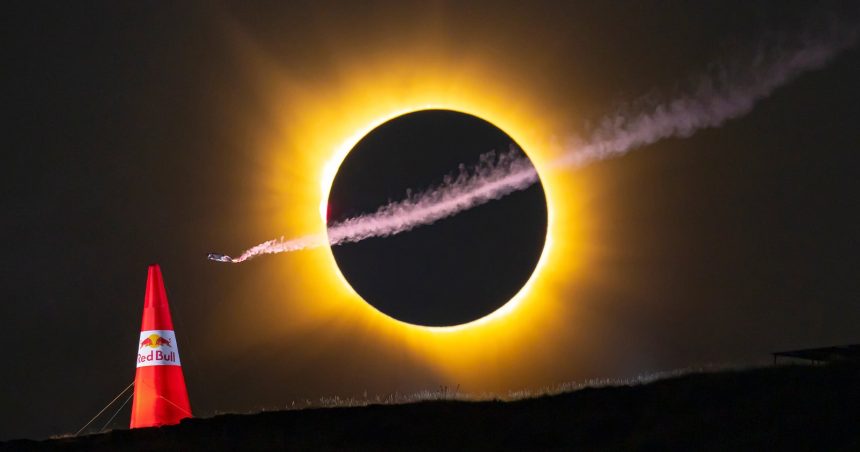
Some photographs happen in a fraction of a second. This one took nine months, roughly 600 hours of planning, and a window that slammed shut after just 84 seconds. On August 12, 2026, over Alarilla, Spain, Red Bull Air Force athlete Mike Brewer launched into a wingsuit flight timed to slice past the moment of total solar eclipse — and photographer Noah Wetzel was waiting nearly a mile away, finger hovering over the shutter.
In an interview with PetaPixel, Wetzel walked through the sheer precision the shot demanded. Totality is not something you can rehearse on the day. Every variable — the sun’s position, the moon’s shadow, Brewer’s trajectory, the exposure — had to be locked in beforehand, because there would be no second attempt and no chance to chimp the histogram and try again.
The hardware was deliberately chosen for reach and reliability:
- Canon EOS R5 II body, doing the heavy lifting from a distance
- a 600mm lens to pull Brewer and the eclipsed sun into a single tight frame from nearly a mile away
- remotely triggered flashes to light the flyer against the darkened sky
That combination is the crux of the whole image. Shoot at 600mm from that far out and you have almost no margin: a slight miscalculation in timing or aim, and Brewer drifts out of frame or the sun is in the wrong place entirely. The remote flashes add another layer of choreography, since firing artificial light onto a subject that far away, at that focal length, during the brief darkness of totality, leaves zero room for a missed cue.
What makes the result compelling isn’t just the gear — it’s how little the gear could do to save the shot if the math were off. Wetzel’s calculations effectively did the composing before Brewer ever jumped. The camera and lens simply had to be pointed and trusted.
Eclipse photography is already an exercise in patience and preparation; totality lasts only as long as nature allows, and here that meant 84 seconds. Adding a human flying through the frame at wingsuit speeds turns a difficult astronomical shot into a logistical high-wire act, where the athlete and the photographer are both racing the same shadow across the ground.
The takeaway for anyone who’s ever cursed a blurry moon shot: even a body as capable as the EOS R5 II paired with a fast 600mm lens is only as good as the planning behind it. Nine months of preparation for a minute and a half of shooting is an absurd ratio — until you see the frame it produced.