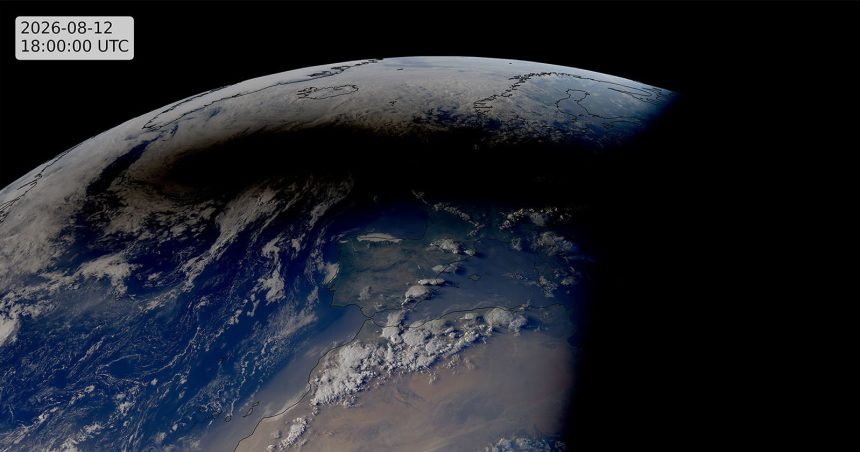
Weather satellites usually spend their days tracking storm fronts and charting climate trends. On August 12, 2026, two of them got a rare day job change: watching the Moon’s shadow race across Europe during a total solar eclipse.
The star of the show was EUMETSAT’s Meteosat-12, parked in geostationary orbit 22,236 miles (35,786 kilometers) above Earth. From that fixed vantage point it permanently monitors Europe and northern Africa — which put it in an ideal seat as totality swept across Greenland, Iceland, Spain, and part of Portugal.
The physics of the event made for a striking image. As darkness raced in from the east, the Moon threw a colossal shadow that slid south. Only the umbra — the darkest core of that shadow — delivered true totality, and it measured just 180 miles (290 kilometers) across. Everyone else inside the broader shaded zone got a partial eclipse instead.
Timing was tight even for those in the sweet spot. Totality lasted at most 2 minutes, 18 seconds, and many locations along the path saw far less. At Station Nord in Greenland, the Sun blinked out for a mere 16 seconds before returning.
Meteosat-12 wasn’t working alone. NOAA’s GOES-19, another geostationary environmental satellite sitting at roughly the same 22,236 miles above Earth, captured multiple video sequences of the umbra crossing the continent. Because GOES-19 is trained on North America rather than Europe, it snagged the eclipse right at the very eastern edge of its field of view — a completely different perspective on the same event, with Iceland and Spain appearing near the horizon of its disk.
The result is a multi-satellite record of a single celestial moment: the shadow tracked in geocolor and visible bands, the terminator sweeping across oceans and ice, all rendered from more than 22,000 miles up. It’s a reminder that the same hardware built to forecast tomorrow’s rain doubles neatly as an astronomical observatory when the geometry lines up.
Down on the ground, photographers across Europe delivered their own haul — wide-angle landscapes going dark at midday and tight close-ups of the Sun’s prominences flaring around the lunar silhouette.
Anyone who missed this one already has the next date circled. The following total solar eclipse falls on August 2, 2027, crossing Spain once again along with northern Africa, Saudi Arabia, and Yemen. Meteosat-12, conveniently, will be well placed to watch that one too.