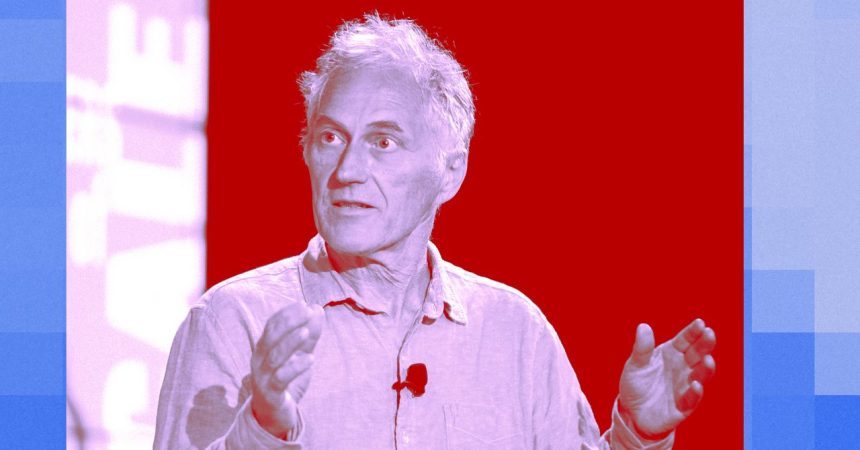
Tim O’Reilly has spent decades measuring the worth of a company by a single rule: create more value than you capture. Now he’s aiming that yardstick squarely at the AI industry, and he doesn’t like what he sees. In a conversation with WIRED’s Steven Levy, the publisher, VC, and longtime internet elder statesman argued that the big AI labs are misreading the future — and that open source will eat their lunch, just as the web once blindsided the PC wars of the 1990s.
His central complaint is architectural. When most people say “open-source AI,” O’Reilly notes, they really mean open-weight models. He wants something bigger: a clean separation between the model, the harness, and the application, so that developers and users can embed their own “special sauce” instead of being funneled into whatever use cases a lab decides to optimize for.
“They built an architecture of control rather than an architecture of freedom and participation,” he says — a design that, conveniently, also lets the labs track you. To O’Reilly, this echoes Microsoft’s 1990s playbook of lock-in, and he thinks the hyperscalers are making the same strategic mistake.
His most provocative claim is that frontier AI may be a dead end for the masses. The latest, largest models used to be better at everything; now, he argues, they’re better at some things and worse at others. He points to chatter that higher-end systems can be weaker writers than lower-level models — a claim Anthropic and OpenAI would dispute. His bet: the giant frontier models end up like mainframes or supercomputers, aimed at genuinely hard problems, while nimble open models diffuse widely through society and drive the real innovation.
There’s a geopolitical edge, too. “We could win frontier AI here in the US, and China will kick our ass because they have lower-level models diffused widely through society,” he warns. On security, he flips the usual script: the cybersecurity incidents we’ve seen, he says, come from frontier models — an argument for slowing them down, not for restricting open weights.
O’Reilly is also backing concrete projects. He cites Pi, an open-source agentic harness, and describes an “open-memory consortium” his nonprofit, the AI Disclosures Project, is exploring — a direct counter to Mark Zuckerberg’s vision of locking users in with an AI that “knows you best.” Open source, he says, should let you switch models and providers while carrying all your context with you.
Then there’s the awkward twist: AI is helping dismantle O’Reilly’s own publishing empire. His book business has slid from roughly $70 million at its peak to $30 million today, and AI now “hoovers everything up.” Yet he remains an enthusiastic user, treating AI as a creative medium — a tool for brainstorming and turning hour-long interviews into usable text.
“AI is literally a medium, in the same way that written words are a medium, or paint or music is a medium,” he says. Refusing to write with it, he predicts, will one day seem as quaint as refusing to make a portrait with a camera. “People used to ride horses. Now, few do. We’re in the early days.”