Robots don’t fail gracefully. When a cyberattack nudges a machine’s behavior in the wrong direction, the consequences aren’t a frozen screen — they’re moving arms, wheels and payloads in the physical world. That’s the problem VicOne is targeting with its new Radeis Extension for NVIDIA Isaac Sim, which arrived on August 9, 2026.
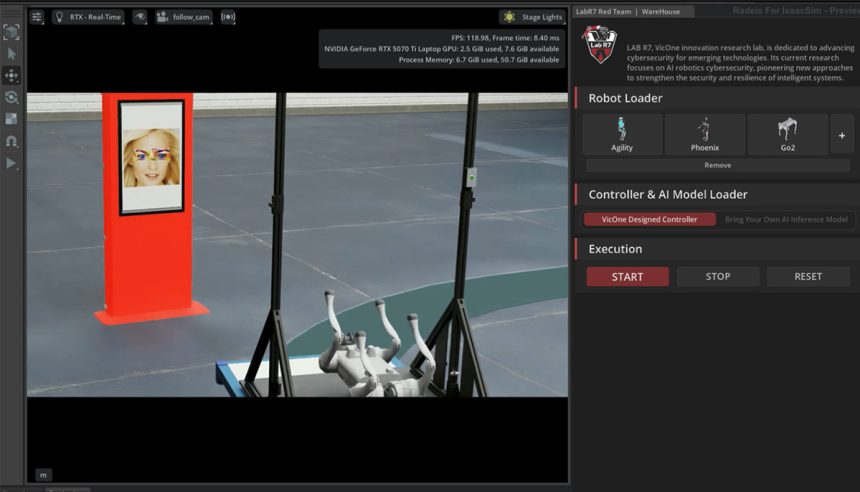
The pitch is refreshingly practical: instead of waiting for a robot to misbehave in the field, developers can simulate how cyberattacks would alter its behavior before deployment. The extension plugs into NVIDIA’s Isaac Sim, the GPU-accelerated robotics simulation platform, and lets engineering teams probe safety failures in a virtual environment where nothing gets broken except assumptions.
What makes this more than a checkbox tool is where it came from. Radeis is built on findings from VicOne’s Physical AI Safety Stress Test CTF, run at the Robotic Hacking Community during DEF CON 34. That’s a capture-the-flag competition where security researchers actively tried to bend physical AI systems to their will — and the lessons learned from those attacks now feed directly into the extension. In other words, the threat models here aren’t theoretical whiteboard scenarios; they’re the kinds of manipulations real hackers reached for when handed a robot and told to break it.
The core idea is behavioral rather than purely network-level. Traditional cybersecurity tooling tends to focus on packets, ports and permissions. Radeis instead asks a more unsettling question: if an attacker gets in, how does the robot’s motion and decision-making actually change? A compromised perception pipeline or tampered control signal can turn a well-calibrated machine into a hazard, and simulating that in Isaac Sim gives teams a way to see the failure modes coming.
A few things worth flagging for anyone deciding whether to grab it:
- Price: free. There’s no paywall between developers and the tool.
- Availability: it’s downloadable now for supported versions of NVIDIA Isaac Sim.
- Audience: robotics teams building physical AI systems who want cyber-safety validation baked into their simulation workflow rather than bolted on after launch.
The timing tracks with a broader shift in the industry. As physical AI — robots that perceive, decide and move in the real world — moves from labs into warehouses, hospitals and streets, the attack surface stops being an IT problem and becomes a safety one. A malicious actor doesn’t need to steal data if they can simply make a robot do the wrong thing at the wrong moment.
Offering the extension for free is a smart move on VicOne’s part: it lowers the barrier to treating cyber-resilience as a design-phase concern instead of a post-incident scramble. Whether developers actually build it into their pipelines is another question — but at least the excuse of “no tools for this” just got weaker.