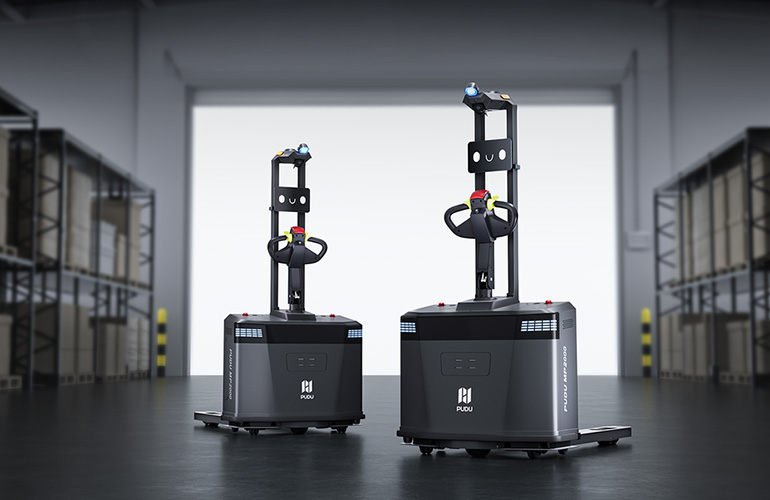
Warehouses are messy, unpredictable places, and that’s exactly the environment Pudu Robotics is targeting with its latest machine. The MP2000, unveiled on August 18, 2026, is an AI-native pallet handling robot built to shuttle serious weight around cluttered industrial floors without a human at the controls.
The headline number is the payload: 2,000 kg. That puts the MP2000 firmly in the territory of full-scale material handling rather than the lightweight tote-carrying bots that have dominated Pudu’s earlier lineup. This is a robot designed to slide its forks under a loaded pallet and move it, repeatedly, all shift long.
What makes that possible is the perception stack. Pudu has fitted the MP2000 with 3D lidar and depth cameras, giving it a rich, three-dimensional understanding of its surroundings. In a warehouse full of moving people, other vehicles, shifting inventory and tight aisles, that kind of spatial awareness is the difference between a robot that navigates confidently and one that spends its day stopped and confused.
Speed matters too, and here the MP2000 makes its case. Pudu quotes fork-in cycles as low as 20 seconds — the time it takes the robot to line up, insert its forks and engage a pallet. Multiply that efficiency across a working day and the throughput gains add up quickly, which is precisely the argument autonomous mobile robot vendors need to make to warehouse operators weighing the cost of automation.
The “AI-native” framing is worth pausing on. Rather than bolting intelligence onto a conventional automated guided vehicle, Pudu positions the MP2000 as a robot conceived around its software brain from the ground up. In practice, that should translate to a machine that copes better with the improvised chaos of real logistics operations — where pallets aren’t always where they’re supposed to be, and the layout changes week to week.
Pudu Robotics has spent recent years best known for its hospitality and service robots, the kind that ferry plates around restaurants and greet guests in hotel lobbies. The MP2000 signals a deliberate push deeper into industrial logistics, where the payloads are heavier, the margins for error are thinner and the competition — from established forklift makers to a growing crowd of autonomy startups — is fierce.
The company hasn’t disclosed pricing, and several finer technical details remain under wraps for now. But the core proposition is clear enough: a self-driving forklift that hauls two tonnes, sees the world in 3D and grabs a pallet in as little as 20 seconds. For warehouse operators chasing round-the-clock throughput without adding headcount, that’s a pitch worth listening to.