Five months ago, Amazon agreed to deploy more than 1 million Nvidia GPUs across its data centers. That already sounded ambitious. Now the number has tripled. In an expanded partnership announced during Nvidia’s quarterly earnings call, Amazon Web Services committed to adding another 2 million Nvidia GPUs to its infrastructure, and Nvidia bluntly noted that since the original deal, “demand has exceeded those expectations.”
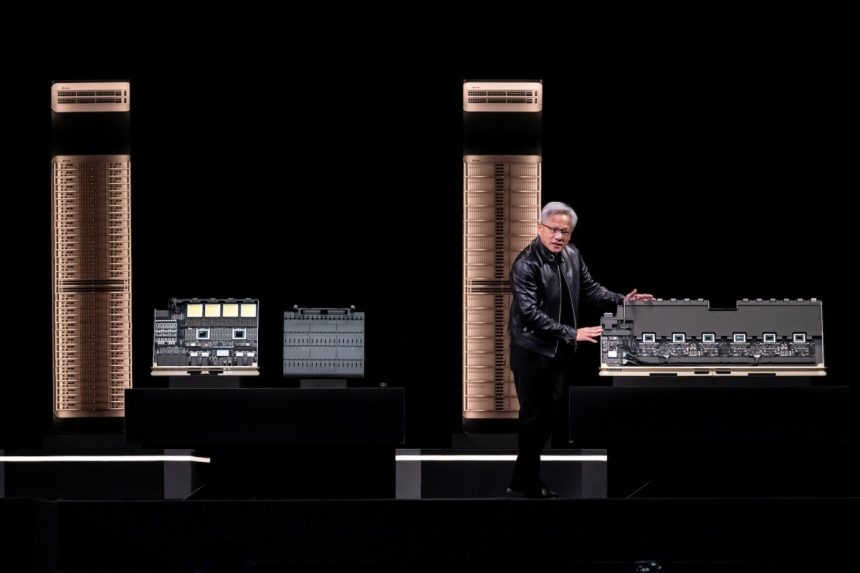
The silicon in question is Nvidia’s heaviest hardware: Blackwell Ultra, Rubin, and Rubin Ultra GPUs, the chips built to train and run large AI models. AWS will begin taking delivery in the third quarter, with the bulk landing in its data centers across 2027 and 2028. Neither company disclosed financial terms, but given per-unit GPU pricing, this is a deal worth tens of billions of dollars.
What makes the announcement more interesting than a giant purchase order is how deep the integration goes. Nvidia said its networking hardware — the fabric that stitches thousands of GPUs into a single system — along with its CPUs, open models, data processing software, and robotics platform, will all be woven into AWS. Alongside the GPUs, Nvidia CFO Colette Kress confirmed an unspecified number of Vera CPUs heading to Amazon, “some integrated with Rubin, others standalone.”
The irony is hard to miss. Amazon has been building its own chips specifically to reduce its dependence on Nvidia — and, increasingly, to compete with it. Its Trainium accelerators are pitched as a direct alternative to Nvidia’s H100 and Blackwell parts for deep learning, and its Arm-based Graviton CPUs challenge server silicon from Intel and AMD. Amazon’s custom chip business recently crossed a $25 billion annualized revenue run rate. And yet, when the workloads pile up, Nvidia still gets the call.
The tie-up spills into robotics, too. Kress said Amazon plans to adopt Nvidia’s full physical AI stack to run its warehouse fleet, including:
- Omniverse — simulation and digital twins
- Cosmos — world model platform
- Isaac — robotics development
- Jetson — computing hardware for robots and edge AI
On the enterprise side, AWS will serve Nvidia’s Nemotron family of open models through Amazon Bedrock and SageMaker.
The numbers behind all this are staggering. Nvidia reported $96.2 billion in second-quarter sales, with data center revenue alone at $89 billion, up 117% year over year. It expects $108 billion in the third quarter, partly fueled by early Rubin shipments that began this quarter. To keep the pipeline flowing, Nvidia has committed a colossal $279 billion to secure supply and manufacturing capacity, up from $119 billion a quarter earlier.
CEO Jensen Huang framed it in his usual sweeping terms: “AI is generating profitable tokens… If we had more compute, we could generate more profitable tokens.” Whether more compute really converts so cleanly into more profit is the trillion-dollar question hanging over the entire industry.