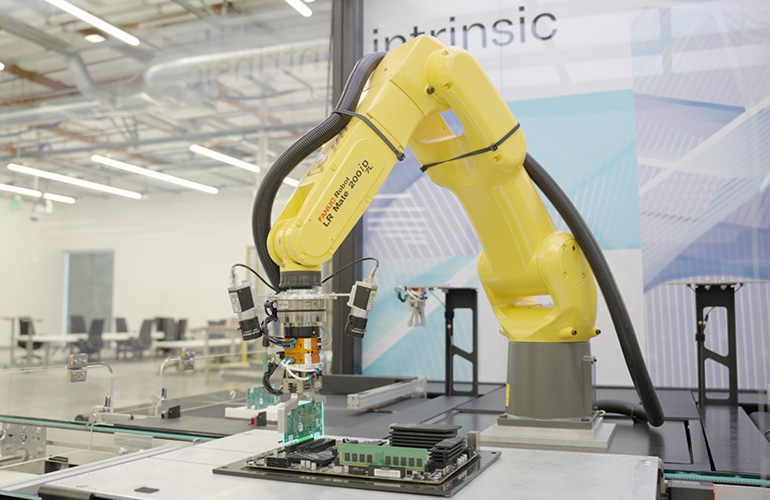
Programming an industrial robot has traditionally meant wrestling with thousands of lines of code, painstakingly defining every joint movement, gripper angle and contingency. Alphabet’s robotics outfit Intrinsic wants that era over — and at Automate 2026 it showed off the tool meant to close the book on it: an AI-powered prototype it calls the Intelligence Cell.
The pitch is refreshingly blunt. Instead of treating a robot like a dumb machine that must be told exactly what to do at every millisecond, Intrinsic’s approach leans on AI to handle the messy, variable parts of factory work — the grasping, the alignment, the adapting to parts that never sit quite where you expected. The goal is to let manufacturers integrate capable robotic behavior without employing a small army of specialist programmers.
This sits on top of the company’s existing foundation. Intrinsic’s flagship platform, Flowstate, is a web-based environment that lets users build robotic applications without writing the customary mountain of code. Rather than scripting motion line by line, engineers assemble and configure behaviors in the browser, then deploy them. The Intelligence Cell extends that philosophy by baking AI-driven perception and manipulation directly into the workflow.
Crucially, Intrinsic isn’t positioning this as a single product you bolt onto one arm. The reference design is meant to give companies everything they need to fold AI-based robotic capabilities straight into their own automation products, running on the firm’s IntrinsicOS. In other words, it’s infrastructure for the people who build the machines, not just the people who operate them.
The corporate backdrop is worth noting too. On February 25, 2026, Alphabet announced it was folding Intrinsic into Google as a distinct business unit, ending the company’s five-year run as a standalone subsidiary. That move puts Intrinsic closer to Google’s broader AI muscle — and the timing, just months before the Automate showcase, suggests the integration is already shaping what the team ships.
What does it mean in practice? A few things stand out:
- Less bespoke engineering. The whole proposition is reducing the manual programming burden that makes automation slow and expensive to roll out.
- AI where it matters. Perception and manipulation are exactly the tasks classical robot code handles badly, and where machine learning earns its keep.
- A platform play. With Flowstate, IntrinsicOS and now the Intelligence Cell, Intrinsic is assembling a stack rather than a one-off gadget.
There are gaps, naturally. Intrinsic operates on a subscription model for enterprise customers, but it hasn’t publicly disclosed pricing for either Flowstate or the Intelligence Cell, and detailed specifications remain under wraps. For now, the demonstration at Automate 2026 is the clearest signal of where Alphabet thinks factory automation is heading: fewer engineers buried in code, more robots that simply figure it out.