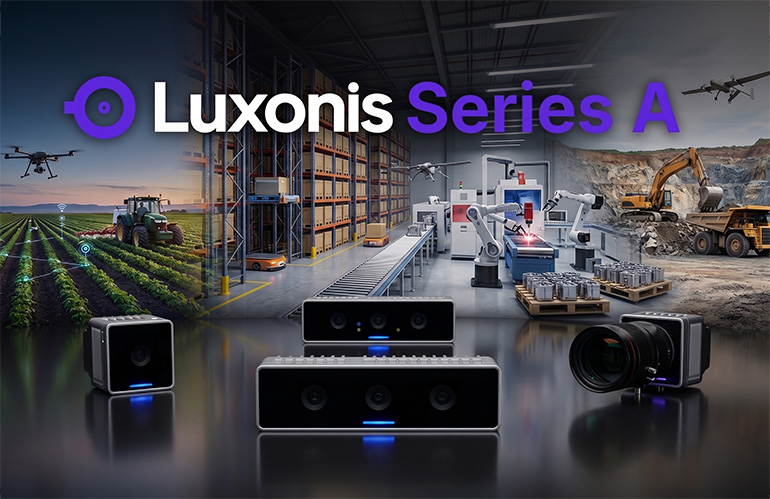
Robots can only act on what they can see, and Luxonis just secured US$14 million in Series A funding to sharpen exactly that ability. The round closed on January 27, 2026, and the company says the cash will go toward scaling production of its OAK camera line while refining the software platform behind it — the perception layer that lets machines make sense of the physical world.
The headline hardware is the OAK 4 family, and it’s a genuine generational leap. Each device runs an onboard Qualcomm QCS8550 processor delivering 52 TOPS of AI inference compute, all handled on the device itself. That’s a 40X increase over the previous generation, which is the kind of number that changes what’s actually possible at the edge — no cloud round-trip, no latency penalty, just perception happening where the action is.
These aren’t stripped-down sensors either. Depending on the model, an OAK 4 packs a stereo depth camera pair, a 48 MPixel RGB camera built around IMX586 rolling shutter sensors, an IR dot projector, an IR illumination LED, a 9-axis IMU, a microphone and a wide field of view. In other words, it’s a full spatial-AI toolkit in a single housing, aimed squarely at robotics developers and industrial automation engineers who’d rather integrate one device than stitch together five.
The lineup is already on sale, and the pricing tiers map neatly onto capability:
- OAK 4 S — from US$749
- OAK 4 D — from US$849
- OAK 4 D Pro — from US$949
- OAK 4 CS — from US$899, available via Early Access with dates aimed at early 2026
What makes Luxonis interesting isn’t any single spec, though. It’s the bet that “physical AI” — machines that perceive, reason and act in real space rather than crunching text in a data center — is about to become a category of its own. Warehouse robots, autonomous forklifts, inspection systems and industrial arms all need dependable, on-device vision that doesn’t fall over when the network hiccups. That’s the market the Series A is meant to unlock.
Pushing 52 TOPS onto a camera you can buy off the shelf is a quietly radical move. It means smaller developers and integrators can build sophisticated depth-aware, object-tracking systems without spending on separate compute boxes or wrestling with cloud pipelines. The funding suggests investors think that democratization has legs — and that the perception layer, long the awkward bottleneck in robotics, is finally ready to scale.