The messy leap from lab demo to live production is where most factory robotics dreams quietly die. Autonomique just cleared it. The Physical AI software company has moved its AI-powered robots out of a pilot program and onto a real production line at F&P Mfg., a Canadian Tier 1 automotive supplier — with ambitions to roll the technology out across F-tech’s global manufacturing network.
What makes this notable isn’t the machine so much as the mission. Autonomique’s platform tackles precision-critical, multi-part assembly — specifically automotive chassis and suspension component manufacturing. These are exactly the fiddly, high-consequence tasks that traditional fixed-function industrial arms handle poorly. Bolt one part slightly out of tolerance and you don’t just scrap a widget; you compromise how a vehicle handles.
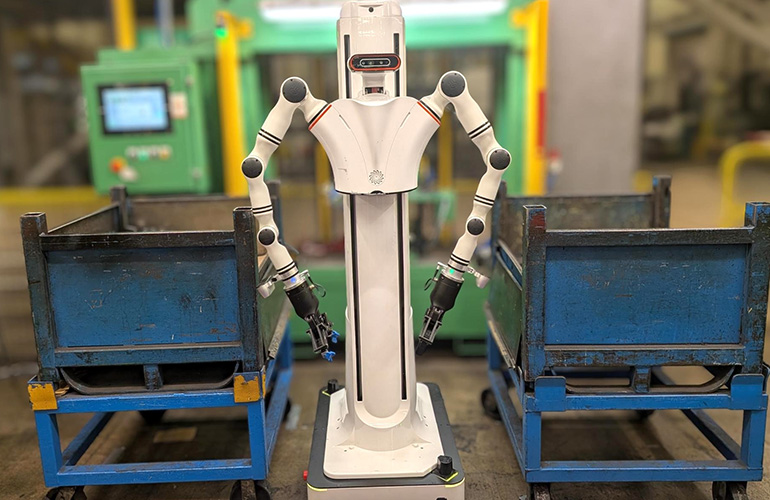
The hardware is a bi-manual wheeled robot — think two coordinated arms on a mobile base rather than a full walking humanoid. That’s a pragmatic choice. Wheels are efficient, stable and cheap to keep upright, while two arms unlock the kind of hold-and-fasten dexterity that single-arm cells can’t manage. Autonomique describes its class of machines as semi-humanoid, and this is what that phrase actually means in practice: human-like manipulation without the balance headaches of legs.
The rollout followed a deliberate timeline. The pilot began in Fall 2025, giving Autonomique and F&P Mfg. months to validate the system against the unforgiving reality of a working assembly line. As of June 2026, those robots moved into live production. Autonomique announced the milestone on June 17, 2026.
The interesting part is the software philosophy. Autonomique bills itself as a Physical AI company, not a robot builder — the intelligence, not the chassis, is the product. That framing matters because it’s what makes the F-tech global expansion plan credible. If the AI can adapt to new parts, new stations and new geographies without a ground-up re-engineering effort each time, then one successful Canadian deployment becomes a template rather than a one-off.
A few things worth keeping in perspective. This is firmly B2B industrial kit, so there’s no consumer price tag, no retail availability and no glossy spec sheet listing payload or reach. That’s normal for this corner of the market — factory automation is quoted per project, not per unit on a shelf.
Still, the signal is clear. Moving from pilot to production is the hardest step in robotics commercialization, and Autonomique has taken it in one of the least forgiving domains there is: automotive precision assembly. Getting a demo robot to impress investors is easy. Getting one to reliably build suspension components, shift after shift, is the whole game — and that’s the bar F&P Mfg. has now cleared with Autonomique’s machines.