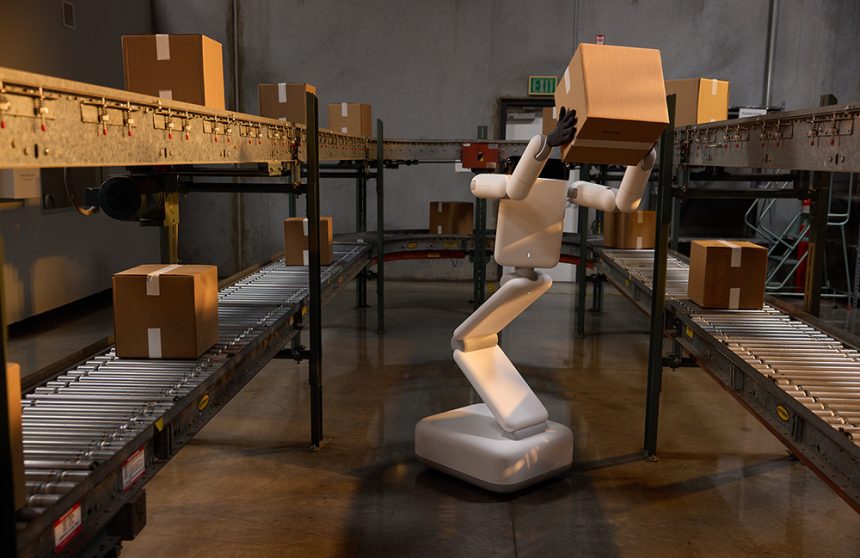
Meet Eno, the first general-purpose robot from Genesis AI — and a machine that quietly rejects the humanoid arms race. Instead of trying to walk like us, Eno rolls. Its wheeled base carries a minimalist tower of articulated panels that adjust their height and reach in real time, then fold down for compact storage when the shift ends. It’s a pragmatic silhouette built for work, not for Instagram.
Where Eno gets human is at the ends of its arms. Genesis fitted the robot with proprietary dexterous robotic hands designed to match the human hand, backed by twenty active, back-drivable degrees of freedom. Back-drivable joints matter here: they let the robot yield to external force rather than fight it, which makes working alongside people and delicate objects far safer. Each arm can handle a payload of three to five kilograms, enough for the bins, trays and tools that fill a warehouse or lab bench.
Running the show is GENE, Genesis AI’s robotics-native foundation model — effectively Eno’s brain. The company also offers an optional screen version with a cognitive interface that surfaces the robot’s intent and reasoning in real time, so a human supervisor can literally watch what the machine is thinking before it acts. In shared workspaces, that transparency is more than a gimmick; it’s a trust feature.
On the endurance front, Eno delivers four to six hours of battery life under normal workloads — enough to cover a meaningful chunk of a shift, though multi-machine fleets will still want a charging rotation.
Genesis AI unveiled Eno on June 16, 2026, and it’s aiming squarely at industry first. The initial rollout targets:
- Manufacturing lines
- Logistics companies
- Laboratories
Production and targeted customer deployments are planned for the end of 2026, with home deployments arriving later down the road. Genesis has not disclosed a price, and Eno is not yet available for consumer purchase.
The strategy is telling. Rather than chase the crowded humanoid segment, Genesis is betting that a wheeled, foldable design with genuinely capable hands is the faster path to real deployments. Whether GENE can generalize across the messy variety of factory and lab tasks is the question that will make or break Eno — but the hardware philosophy is refreshingly grounded.