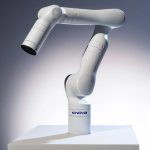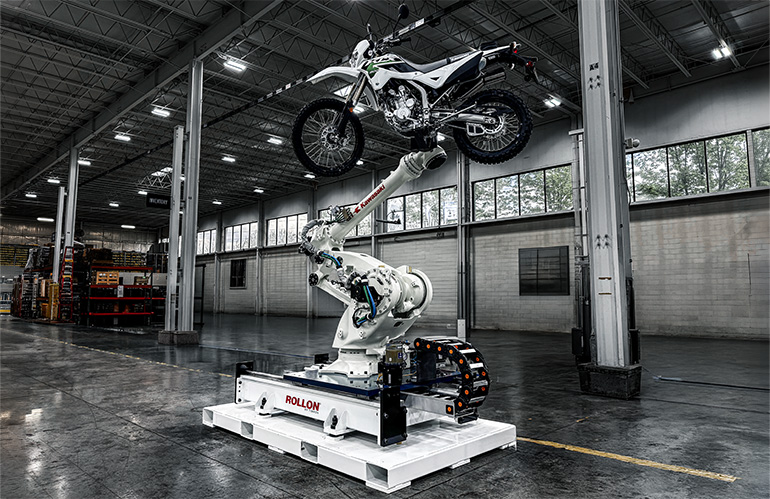
Six-axis robots have been the industrial workhorse for decades, but Kawasaki Robotics just tore a page from that rulebook. The RL030N ships with an eighth degree of freedom, and that extra articulation axis is the whole point — it lets the arm reach around obstacles, twist through confined spaces, and hold awkward poses that would leave a conventional six-axis machine stranded.
The RL030N made its public debut at Automate 2026, held June 22–25 at McCormick Place in Chicago, after being announced on June 16. Kawasaki positions it as a “physical AI” platform rather than just another arm — and the specs back up the ambition.
Here’s what the numbers look like:
- 8 degrees of freedom, versus the industry-standard six, for markedly greater dexterity and flexibility
- 30 kg maximum payload
- ±0.03 mm repeatability
- Maximum reach just under two meters
- Lightweight construction tuned for dynamic and confined environments
The real story, though, is the software layer. The RL030N runs on Kawasaki’s open KRNX real-time control API, which is where the “physical AI” label earns its keep. Instead of locking motion planning inside a proprietary controller, KRNX opens a direct line for external systems to drive the robot in real time — think AI software, ROS environments, machine learning stacks, vision platforms, and third-party orchestration tools all issuing commands on the fly.
That matters because the next wave of automation isn’t about pre-programmed pick-and-place loops. It’s about robots reacting to messy, unpredictable conditions — and an arm that can be steered live by an external brain, rather than one that only executes a fixed script, is a very different animal. Pair real-time external orchestration with high-speed motion and the eighth axis, and you get a machine designed to adapt mid-task instead of grinding to a halt.
Kawasaki didn’t bring the RL030N to Chicago in isolation. The company used Automate to lay out a broader vision for intelligent automation, showing the eight-axis platform alongside its Pulseboard inspection technology and other systems — a portfolio pitch aimed at manufacturers who want smarter, more flexible cells rather than a single new arm.
What’s still unclear is when — and for how much — buyers can actually get their hands on one. Kawasaki hasn’t disclosed pricing or general availability, so for now the RL030N remains a statement of intent as much as a product on a shelf. But as a signpost for where industrial robotics is heading — dexterous hardware, open control, and AI in the driver’s seat — it’s a sharp one.