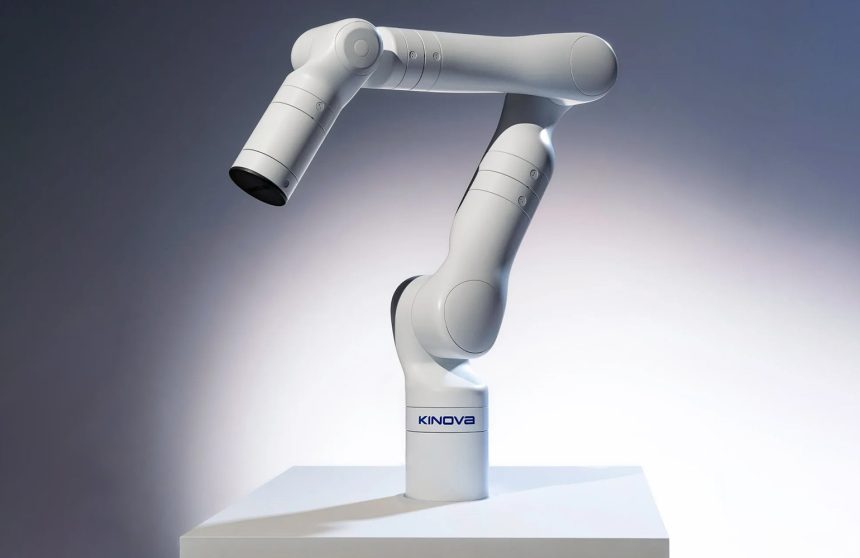
Most surgical robots trace their DNA back to the factory floor — industrial arms retrofitted with sterile drapes and clinical software. Kinova took a different route. Its new KIMA robotic arm was engineered from scratch for the operating room, and the design choices show it.
The Quebec-based company, headquartered in Boisbriand, unveiled KIMA on June 9, 2026, with an official showing at the Society of Robotic Surgery (SRS) 2026 Annual Meeting. Rather than muscling in with heavy industrial hardware, Kinova leaned into precision and portability — two things that matter a great deal when an arm has to share cramped space with a surgical team.
Let’s talk numbers. KIMA carries a payload of 3 kg (6.6 lb.), which is plenty for the instrumentation and end-effectors a surgical platform typically needs to wield. What’s more impressive is the frame: the whole thing tips the scales at under 13 kg (28.6 lb.). That’s light enough to reposition without a forklift, and it hints at a design philosophy aimed at flexible, space-conscious clinical setups.
Under the hood, Kinova went with an open architecture and EtherCAT communication protocols, plus a controller-less design. In practical terms, that means fewer bulky external boxes cluttering the room and a system that integrators can actually build on rather than fight against. Open architecture is a rarity in a field that tends to lock partners into proprietary walled gardens, so this is a genuinely notable move.
Then there’s the part that separates a lab curiosity from something you’d let near a patient: regulatory rigor. KIMA integrates software developed to IEC 62304 Class C — the most stringent classification, reserved for software whose failure could cause serious injury or death — and adheres to ISO 14971 risk-management standards. These aren’t marketing badges; they’re the baseline expectations for any device that wants a realistic path to clinical deployment.
The bigger story here is strategic. By building a purpose-made component instead of adapting an industrial arm, Kinova is positioning KIMA as a foundation for medical device makers who want to develop their own robotic surgery platforms without reinventing the motion-control wheel. It’s a picks-and-shovels play in a gold rush that’s still very much underway.
- Payload: 3 kg (6.6 lb.)
- Weight: under 13 kg (28.6 lb.)
- Communication: EtherCAT, controller-less, open architecture
- Compliance: IEC 62304 Class C software, ISO 14971 safety
Kinova hasn’t disclosed pricing or a firm availability window, and for a component destined to live inside other companies’ systems, that’s not unusual — those details tend to arrive through partnership channels rather than a spec sheet. For now, KIMA reads like a confident bet that clinical robotics deserves hardware designed specifically for it.